
Table of Contents
Table of Contents
The search for zookeeper cluster retirement kafka usually starts after a team has already made the obvious decision. ZooKeeper is no longer the future control plane for Kafka, Kafka 4.0 runs without ZooKeeper, and the operational case for retiring older clusters is hard to ignore. The harder question is what to validate before moving production traffic.
That question matters because a ZooKeeper-era Kafka cluster is rarely only a metadata system plus a set of brokers. It is a living production contract. Applications depend on client behavior, topic names, partition counts, ACLs, consumer offsets, retention windows, connector tasks, monitoring dashboards, runbooks, and incident muscle memory. Retiring the cluster means replacing all of that without turning the old cluster into a permanent safety net.
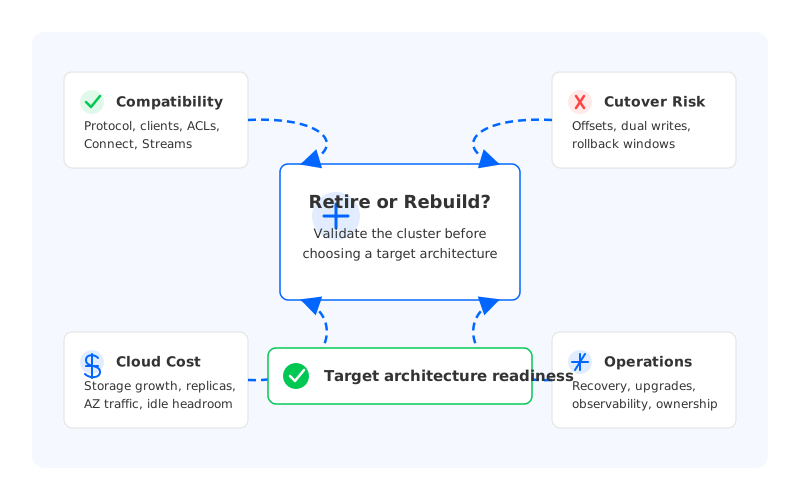
The mistake is treating cluster retirement as an upgrade ticket. For many platform teams, it is closer to a change in operating model. You are deciding how much broker-local storage, manual capacity planning, cross-zone replication traffic, and repair work you still want to own after the migration.
1Why teams search for zookeeper cluster retirement kafka
The immediate trigger is often version pressure. Apache Kafka 4.0 is a major milestone because it operates entirely without ZooKeeper and runs in KRaft mode by default. That does not mean every older cluster must be replaced overnight, but it changes the long-term planning baseline. Teams that delay the decision still need a credible path for security updates, client compatibility, broker upgrades, and operational support.
The second trigger is organizational. ZooKeeper-era clusters tend to survive because they are stable enough to avoid attention, not because they are easy to operate. The platform team knows which brokers are fragile, which topics cannot tolerate a reassignment, and which consumer groups need special handling. That knowledge is valuable, but it is also a dependency. A retirement project exposes it.
The third trigger is cloud economics. Traditional Kafka was designed around brokers that own local log storage and replicate partitions across brokers. In a cloud deployment, that model turns durability and availability into compute, block storage, and network decisions. A cluster can be healthy while still carrying idle capacity, storage growth, and traffic patterns that are hard to explain in a FinOps review.
So the first validation step is not "Can we migrate?" It is "What are we trying to stop owning?"
2The production constraint behind the problem
Kafka's shared-nothing design couples compute and storage at the broker. A broker is not a disposable process if it owns unique local replicas for many partitions. When you replace it, expand it, shrink it, or rebalance it, the cluster must move data. That is a reasonable design in many environments, but it creates real friction when the retirement goal is to reduce operational work.
This coupling affects retirement in four ways:
- Capacity is local. A cluster may have enough aggregate disk, but the wrong broker can still run hot. Retirement planning has to model partition placement and data movement, not only total throughput.
- Recovery is data-bound. Broker replacement speed depends on how much data must be copied, how fast the storage and network path can move it, and how much replication pressure the cluster can tolerate during business traffic.
- Cost follows replicas. Replication is necessary for durability, but it also multiplies storage and traffic considerations. In multi-AZ cloud deployments, the bill is shaped by placement, replication topology, and consumer access patterns.
- Change windows become scarce. Reassignment, rolling upgrades, client cutovers, and connector migrations all compete for the same operational attention. A retirement project that ignores this becomes a series of late-night exceptions.
None of these points means traditional Kafka is wrong. They mean the retirement plan must be honest about the architecture it is preserving. If the target platform keeps brokers stateful and storage local, the team may remove ZooKeeper while keeping the same basic scaling and repair model.
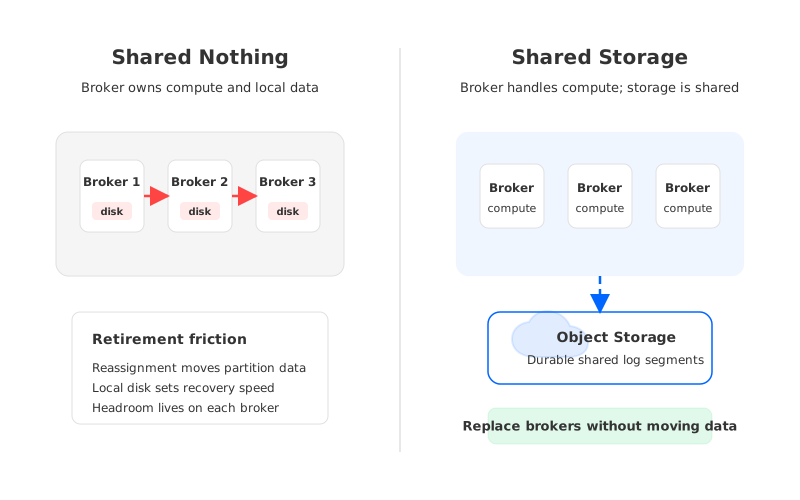
That is why a neutral evaluation framework is useful. It prevents the project from collapsing into a narrow version discussion, and it gives engineering leaders a way to compare KRaft migration, managed Kafka, and Kafka-compatible cloud-native systems using the same production criteria.
3Architecture options and trade-offs
There are three common paths out of a ZooKeeper-era cluster. Each can be valid, but each optimizes for a different operating outcome.
| Option | What changes | What stays important | Best fit |
|---|---|---|---|
| In-place Kafka evolution | Move toward KRaft and current Kafka versions | Broker-local storage, partition reassignment, capacity planning | Teams that want Apache Kafka continuity and have strong Kafka operations |
| Managed Kafka service | Shift more infrastructure responsibility to a provider | Service limits, networking, cost model, migration tooling | Teams that want less infrastructure ownership within a cloud provider boundary |
| Kafka-compatible cloud-native platform | Keep Kafka APIs while changing the storage and operations model | Compatibility proof, cutover plan, governance, rollback | Teams using retirement to reduce broker-state operations and cloud cost exposure |
The table is deliberately plain. Architecture decisions become risky when every option is described with its own vocabulary. What matters is whether applications, data contracts, and operations survive the move with fewer hidden obligations than before.
Compatibility is the first gate. Kafka clients are not only producers and consumers. A real estate of dependencies often includes Admin API automation, schema registry integrations, Kafka Connect, Kafka Streams, MirrorMaker-style replication, ACL tooling, monitoring agents, Terraform modules, and incident scripts. The target does not need to be identical in every implementation detail, but it must preserve the behaviors your workloads actually use.
Data movement is the second gate. A retirement plan should inventory topic sizes, retention policies, compacted topics, internal topics, consumer group offsets, transactional workloads, and connector state. The risky topics are not always the largest ones. A small compacted topic can carry critical reference data; an internal connector topic can determine whether downstream systems resume cleanly; a consumer group with strict replay semantics can turn a simple cutover into an application incident.
Cost is the third gate, and it should be modeled before the migration tool is selected. The useful model is not a single monthly number. It separates broker compute, storage, retained data, cross-AZ traffic, operational headroom, observability, and recovery capacity. Without that breakdown, a team can retire an old cluster and still reproduce the same cost curve in a cleaner dashboard.
Governance is the fourth gate. Security teams care about encryption, private networking, identity integration, auditability, region control, and who can operate the cluster. Platform teams care about who owns broker upgrades, scaling events, topic policy, quota enforcement, and emergency access. These are not paperwork details. They define whether the target can replace the old production boundary.
4Evaluation checklist for platform teams
The fastest way to make the project concrete is to score the current cluster and target platform against the same checklist. Do this before a migration proof of concept. A PoC that only proves throughput can hide the work that will decide the production outcome.
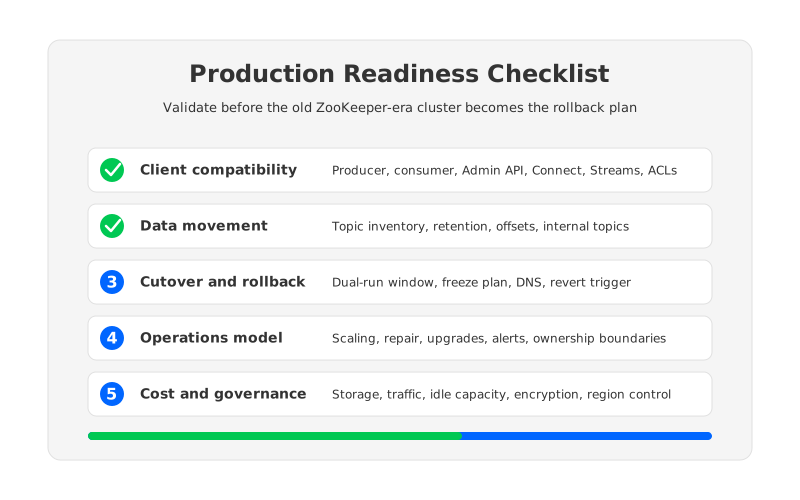
Start with a topic and client inventory. For each workload, record producer owners, consumer owners, client versions, authentication method, throughput, retention, compaction setting, partition count, lag tolerance, and replay requirements. This sounds tedious because it is. It is also the difference between a planned retirement and a sequence of application-specific surprises.
Then define the cutover strategy. Some workloads can move through a short freeze and DNS or bootstrap-server change. Others need dual writes, mirroring, offset translation, or a staged consumer migration. The retirement plan should name the rollback trigger in advance: unacceptable error rate, lag growth, connector failure, authorization mismatch, or data validation failure. Rollback is not a mood. It is a condition.
The checklist should cover at least these validation areas:
- Client behavior: Verify producers, consumers, Admin API usage, transactions, idempotent writes, security settings, and expected error handling against the target platform.
- Data continuity: Validate retained data, compacted topics, consumer offsets, connector state, and any internal topics that must move or be recreated.
- Operational readiness: Confirm scaling procedures, upgrade ownership, repair behavior, alert thresholds, audit logs, and incident escalation.
- Network and security: Validate private connectivity, encryption, identity integration, ACL migration, region placement, and data sovereignty requirements.
- Cost envelope: Model normal load, peak load, retained data growth, replication or mirroring traffic, recovery capacity, and idle headroom.
- Rollback: Define a time-bounded rollback path while the old cluster is still authoritative enough to serve that role.
The old cluster should not remain in limbo. If the target cannot pass these checks, the team has learned something useful before production traffic moves. If it does pass, the retirement project can proceed with evidence instead of confidence theater.
5How AutoMQ changes the operating model
Once the validation framework is in place, the AutoMQ option becomes easier to evaluate without turning the article into a product comparison. AutoMQ is a Kafka-compatible cloud-native streaming platform that keeps Kafka protocol compatibility while separating broker compute from durable storage. In practical terms, the broker is no longer the long-term owner of local log data in the same way a traditional Kafka broker is.
That architectural change is relevant to ZooKeeper-era retirement because many retirement pains are storage-coupling pains. If brokers can be treated as more stateless compute nodes and durable log data is backed by object storage, then scaling, replacement, and recovery stop being dominated by broker-local data movement. The team still has to validate compatibility, migration, security, and operations, but the target operating model is different.
AutoMQ documentation describes the system as using shared storage architecture with stateless brokers and object-storage-backed persistence. It also documents migration from Apache Kafka to AutoMQ, which matters because retirement projects need a path that respects existing Kafka applications rather than asking application teams to rewrite at the same time. The interesting point is that the retirement question shifts from "How do we move every partition safely?" to "Can we preserve Kafka contracts while removing broker-local storage as the center of operations?"
That shift has cost implications as well. In a traditional deployment, the platform team often buys capacity for data durability, recovery margin, and growth at the broker layer. In a shared-storage design, compute and storage can be scaled more independently. The right way to evaluate the claim is not to accept a slogan. Build a workload model: ingress, egress, retention, partition count, peak hours, recovery objective, region placement, and security boundary. Then compare how each target architecture pays for the same obligations.
There is also a governance benefit, but it is more subtle. A retirement project is easier to approve when the target keeps the deployment boundary clear. Teams running in their own cloud accounts or controlled environments still need private networking, identity integration, encryption controls, and operational visibility. A Kafka-compatible platform should make those responsibilities easier to reason about because storage, compute, and control boundaries are explicit.
AutoMQ should enter your plan after the checklist, not before it. If the checklist says your main risk is unsupported client behavior, solve that first. If it says your main burden is broker repair, local storage growth, and cloud traffic created by a stateful broker model, then a shared-storage Kafka-compatible architecture deserves a serious proof of concept.
6A practical retirement sequence
A workable sequence starts with observation, not migration tooling. Freeze the inventory of the old cluster for a defined measurement window. Capture topic growth, throughput, consumer lag patterns, failed produce or fetch requests, broker disk trends, reassignment history, under-replicated partition events, controller events, connector restarts, and access-control changes. This becomes the baseline the target must beat or preserve.
Next, build a target scorecard. Give each workload a readiness level: ready for direct cutover, needs compatibility testing, needs offset or connector planning, needs application owner involvement, or should remain on the old cluster. The scorecard prevents high-volume but simple workloads from masking low-volume but critical ones.
Then run a migration rehearsal with representative traffic. Do not call it a success because messages flowed from producer to consumer. A useful rehearsal proves that monitoring works, permissions are correct, lag behaves under backpressure, connector tasks recover, rollback can be executed, and the team can explain cost under test load.
Finally, retire in slices. Move low-risk workloads first, keep the old cluster authoritative only for workloads that still need it, and remove dependencies as they clear. The end state should be boring: no application still points at the old bootstrap servers, no connector task depends on old internal topics, no dashboard treats old broker metrics as a production signal, and no runbook says "ask the person who built the cluster."
The whole point of retiring a ZooKeeper-era cluster is to stop carrying the old operating model forward by accident. If you are evaluating a Kafka-compatible shared-storage target, the AutoMQ migration documentation is a practical next step for planning a controlled proof of concept around your own topics, clients, and recovery constraints.
7References
- Apache Kafka: Apache Kafka 4.0.0 Release Announcement
- Apache Kafka: Upgrading to Kafka 4.0
- AutoMQ: What is AutoMQ
- AutoMQ: Technical Advantage Overview
- AutoMQ: Migrating from Apache Kafka to AutoMQ
- AWS: Amazon S3 data consistency model
- AWS: Amazon VPC pricing
8FAQ
8.1Is ZooKeeper retirement the same as a Kafka upgrade?
No. An upgrade changes software versions and sometimes metadata mode. A retirement project replaces a production cluster boundary. It must validate clients, topics, offsets, connectors, security, monitoring, rollback, and operating ownership.
8.2Should every ZooKeeper-era Kafka cluster move directly to KRaft?
Not automatically. KRaft is the Apache Kafka control-plane direction, and Kafka 4.0 runs without ZooKeeper. The target choice should still depend on whether the team wants to preserve the existing broker-local storage model, move to managed Kafka, or use the retirement event to evaluate a Kafka-compatible cloud-native architecture.
8.3What is the highest-risk part of retiring an old Kafka cluster?
The highest risk is usually hidden dependency, not raw data copy. Consumer offsets, compacted topics, connector internal topics, ACL assumptions, older client versions, and undocumented operational scripts can create more trouble than large but straightforward topic data.
8.4Where does AutoMQ fit in the decision?
AutoMQ fits when the team wants Kafka compatibility but also wants to change the operating model around storage, scaling, and broker replacement. It should be evaluated through the same compatibility, migration, governance, and cost checklist as any other target platform.
8.5When can the old cluster be shut down?
Shut it down after no production clients use it, required data has moved or expired by policy, monitoring no longer treats it as authoritative, and rollback windows have closed. Application owners should also sign off on their workloads.


