
Table of Contents
Table of Contents
Teams do not search for zookeeper retirement kafka because they want another history lesson about Kafka metadata. They search for it when a production estate has reached a decision point: an older cluster still depends on ZooKeeper, a platform roadmap points toward KRaft, a cloud bill keeps growing, and every application owner wants to know whether the migration will disturb their producers, consumers, connectors, and dashboards. The hard part is not admitting that ZooKeeper should leave the critical path. The hard part is proving that the target path preserves the operational contracts the business already depends on.
That distinction matters because ZooKeeper retirement is often framed as a control-plane upgrade, while the risk lands across the whole streaming platform. Metadata movement is only one part of the plan. Client compatibility, ACL behavior, broker replacement, topic configuration, cross-AZ replication traffic, consumer offset handling, connector recovery, and rollback timing all become part of the same change window. A clean KRaft quorum helps, but it does not by itself answer whether the storage model, cost model, and team boundary still fit the next several years of Kafka usage.
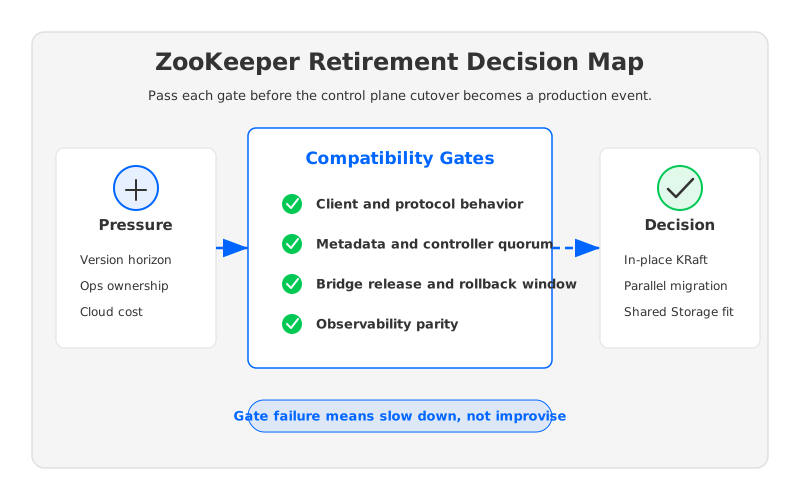
The most useful way to approach the project is to treat it as a set of compatibility gates. Each gate should produce evidence, not confidence theater. If a gate fails, the answer is not to improvise a heroic cutover. The answer is to slow down, reduce scope, or choose a migration path that keeps the business reversible for longer.
1Why teams search for zookeeper retirement kafka
ZooKeeper retirement usually starts with version pressure. Kafka's KRaft mode replaces the external ZooKeeper dependency with Kafka's own metadata quorum, and Apache Kafka documentation for current 4.x lines documents KRaft operations and differences from ZooKeeper mode. For teams still operating ZooKeeper-based clusters, that moves retirement from a nice-to-have cleanup into a lifecycle decision. You can keep older infrastructure alive, but the operational burden compounds as client libraries, security baselines, automation, and vendor support move forward.
The second trigger is ownership pressure. ZooKeeper-based Kafka estates often carry years of local scripts and tribal knowledge: who can restart a broker, which metrics indicate controller instability, which topic policies are enforced by custom plugins, and which client teams still use older protocol features. KRaft reduces one external system, but it also changes several operational surfaces. For example, some ZooKeeper-era configurations and metrics are removed or replaced, controller roles become explicit, and feature levels are managed through Kafka tooling rather than the older inter-broker protocol version model.
The third trigger is cloud economics. Traditional Kafka durability depends on replicated logs across brokers. In a multi-Availability Zone design, that often means multiple local copies of retained data plus network traffic created by replica catch-up, leader movement, and consumer placement. The cloud makes compute easier to add, but it also prices network, block storage, and headroom in ways that make "keep the same architecture and upgrade metadata" an incomplete answer. When a ZooKeeper retirement plan ignores this cost layer, the team may finish the migration and still inherit the same scaling pain.
2The migration risk behind the workload
Kafka is unusually sensitive to partial compatibility because the platform is both an infrastructure system and an application contract. Producers care about acknowledgments, idempotence, transactions, compression, and retry behavior. Consumers care about offsets, rebalancing, lag, ordering, and recovery after failure. Platform teams care about ACLs, quotas, metrics, log retention, topic creation policy, rolling restarts, broker replacement, and disaster recovery. A ZooKeeper retirement plan that validates only broker startup is validating the smallest part of the problem.
The compatibility gate should therefore start with the workload inventory, not the target cluster. A payments topic with transactional producers has a different risk profile from an analytics firehose with replay-tolerant consumers. A Kafka Connect deployment with hundreds of source and sink tasks has a different risk profile from a small group of custom services. A platform that relies on dynamic configuration changes, custom principal builders, or controller-adjacent policy plugins needs to map those assumptions to the KRaft operating model before any production cutover.
| Gate | What to prove | Failure signal |
|---|---|---|
| Client behavior | Producers, consumers, admin clients, Streams apps, and connectors work with target broker versions and security settings. | Hidden library drift, unexpected rebalance behavior, or missing admin permissions. |
| Metadata behavior | Topic configs, ACLs, quotas, policies, controller metrics, and feature levels are visible and manageable. | Scripts still assume ZooKeeper paths, deprecated configs, or removed metrics. |
| Data movement | Retention, replication, reassignment, and catch-up reads fit the maintenance window. | Broker replacement or partition movement takes longer than the rollback window. |
| Cost model | Cross-zone traffic, storage copies, compute headroom, and retained data growth are modeled together. | The upgrade removes ZooKeeper but leaves the same recurring cloud waste. |
| Rollback | The team knows which actions are reversible, for how long, and by whom. | The first failed validation requires a live architectural debate. |
The rollback row deserves special attention. Rollback in Kafka is not equivalent to "restart the old process." The write path may have accepted additional data, consumers may have committed offsets, connectors may have advanced external system state, and feature levels may have crossed a line that changes compatibility. Treating rollback as a documented state machine is more honest than treating it as a calendar slot.
3Compatibility, replication, rollback, and observability trade-offs
ZooKeeper retirement has two broad paths. An in-place migration preserves more of the existing platform shape but concentrates risk in the live cluster. A parallel migration gives the team more room to validate behavior, mirror data, and run controlled cutovers, but it adds temporary complexity around synchronization, offsets, DNS or bootstrap changes, and duplicate operational surfaces. Neither path is universally safer. The safer path is the one whose failure modes your team can observe and reverse.
Replication strategy is where the decision becomes concrete. MirrorMaker 2 and similar cross-cluster replication patterns can support a parallel migration, but they do not erase semantic questions. Which topics need strict ordering guarantees during cutover? Which consumers can restart from translated offsets? Which downstream systems tolerate duplicate writes? Which connectors need pause-and-resume choreography? A platform team that answers those questions before the migration window will make fewer irreversible decisions under pressure.
Observability has to move with the plan. ZooKeeper-era dashboards often mix broker health, controller events, ZooKeeper sessions, ISR behavior, request latency, disk usage, and consumer lag. KRaft changes the metadata layer, so the signal map must change too. The goal is not to make the old dashboard look green. The goal is to know whether the target control plane, brokers, clients, storage, and network are all behaving within the envelope that production workloads need.
The storage trade-off is the piece many teams discover late. KRaft removes the external metadata dependency, but it does not make a traditional Kafka broker stateless. If durable logs remain tied to broker-local disks, then broker replacement, partition reassignment, scaling, and failure recovery still involve moving or rebuilding retained bytes. That may be acceptable for a stable cluster with modest retention and mature automation. It becomes expensive when traffic is bursty, retention grows, or multi-AZ replication dominates the operating budget.
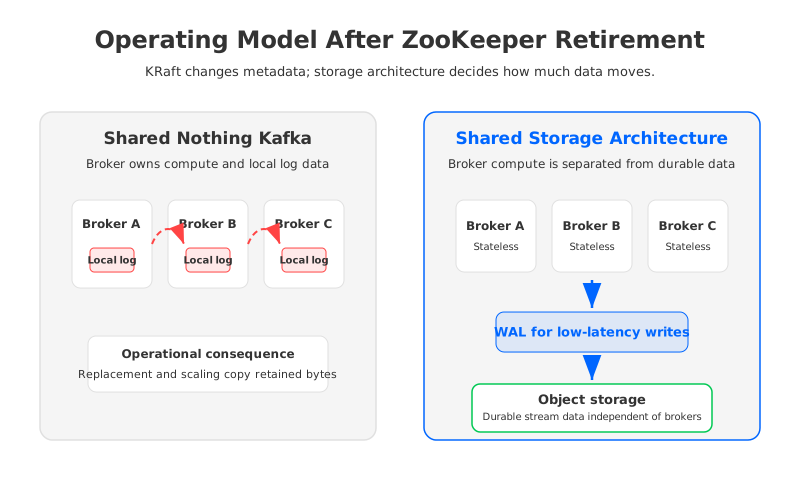
This is why the retirement project should include an architecture decision, not only an upgrade checklist. The question is not "KRaft or ZooKeeper?" anymore. The question is whether the target Kafka-compatible platform should keep the traditional Shared Nothing storage model, use tiered storage for older segments, or move toward a Shared Storage architecture where durable stream data is separated from broker compute.
4Evaluation checklist for migration teams
A practical readiness checklist should fit on one page, but it should be strict enough to stop the project when the evidence is weak. The point is not to create process for its own sake. The point is to prevent a control-plane migration from becoming a data-plane incident.
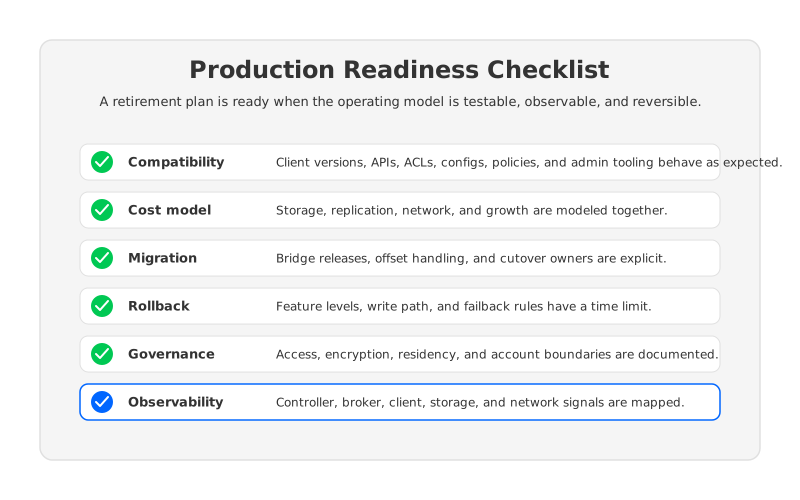
Start with compatibility. Confirm the minimum and maximum client versions in use, then test the real client mix against the target platform. Include producer acknowledgments, idempotent and transactional workloads, consumer group rebalancing, offset commits, admin operations, SASL or mTLS authentication, ACL enforcement, quotas, and the command-line tools your operators use during incidents. Compatibility is not a marketing label; it is the sum of the behaviors your applications exercise.
Move next to migration mechanics. For in-place migrations, define the bridge release, controller quorum design, feature-level steps, broker restart order, and stop conditions. For parallel migrations, define topic selection, replication direction, offset handling, validation duration, cutover ownership, and failback policy. Keep the first production wave boring: low criticality, representative traffic, clear rollback criteria, and enough retention to replay the test if needed.
Cost and capacity should be modeled before the target architecture is chosen. A ZooKeeper retirement project is a rare chance to revisit old assumptions about disk headroom, replica placement, cross-zone network traffic, and retained data growth. If the target keeps broker-local storage, the team should budget for data movement during failure recovery and scaling. If the target uses object storage, the team should validate write latency, WAL behavior, read path performance, object storage permissions, and operational visibility.
Governance then decides where the platform can run. Some teams want a fully managed service boundary. Others need BYOC or private deployment because data, keys, audit logs, network paths, or cloud accounts must remain under customer control. ZooKeeper retirement should not blur that boundary. It should clarify who can access metadata, who can operate the cluster, where durable data lives, and how the organization proves compliance during and after the migration.
5How AutoMQ changes the operating model
Once the gates are explicit, AutoMQ enters the evaluation as an architectural option rather than a shortcut. AutoMQ is a Kafka-compatible cloud-native streaming platform that keeps Kafka protocol and ecosystem compatibility while replacing the broker-local storage layer with a Shared Storage architecture. The important shift is not cosmetic. It changes what a broker is responsible for during scaling, replacement, and recovery.
In traditional Kafka, the broker is both compute and durable storage owner. In AutoMQ's architecture, brokers are designed to be stateless from the durable data perspective. Stream data is written through a WAL layer for low-latency persistence and then stored in object storage as the durable backing store. That means broker replacement is closer to replacing compute capacity, while durable retained data remains outside the broker lifecycle. For a ZooKeeper retirement project, that changes the evaluation from "can we remove ZooKeeper?" to "can we reduce the amount of state that makes every future operation risky?"
The effect shows up in several gates:
- Compatibility remains the first gate because migration risk begins at the Kafka API boundary. AutoMQ documents Kafka compatibility and migration paths so teams can test producers, consumers, Kafka Connect, and operational tooling against the behaviors they use.
- Cost becomes easier to reason about when retained data is not multiplied across broker-local disks in the same way. AutoMQ also documents cross-zone traffic reduction patterns, which matter for multi-AZ Kafka estates where replication and reads can create recurring network charges.
- Elasticity changes because partition reassignment no longer needs to copy the full local log between brokers. The practical benefit is not "scaling is magic"; it is that scaling and balancing are less coupled to retained-byte movement.
- Governance remains under architectural control. AutoMQ supports deployment models where the data plane runs in the customer's cloud boundary, which is relevant when the migration is tied to data residency, cloud account ownership, or private networking constraints.
There are still trade-offs to validate. Object storage is not a free lunch for latency-sensitive streaming, which is why the WAL layer and read-path design matter. Teams should test their own producer latency, catch-up reads, failover behavior, metrics, and cloud permissions. The advantage of evaluating AutoMQ during ZooKeeper retirement is that the project already has the right test harness: compatibility gates, migration runbooks, rollback criteria, and operating-cost evidence.
If your ZooKeeper retirement review keeps returning to broker-local data movement, cross-AZ replication cost, or slow broker replacement, test the storage model directly. Start with the AutoMQ GitHub project and run your compatibility gates against a Kafka-compatible Shared Storage architecture before locking the next operating model.
6References
- Apache Kafka documentation: KRaft operations
- Apache Kafka documentation: KRaft vs ZooKeeper
- Apache Kafka KIP-500: Replace ZooKeeper with a self-managed metadata quorum
- Apache Kafka KIP-405: Kafka Tiered Storage
- Apache Kafka KIP-1150: Diskless Topics
- AWS EC2 pricing: data transfer
- AWS documentation: Amazon S3 user guide
- AWS fault isolation boundaries: Availability Zones
- AutoMQ documentation: Apache Kafka compatibility
- AutoMQ documentation: Shared Storage architecture
- AutoMQ documentation: migration overview
- AutoMQ documentation: eliminate inter-zone traffic
7FAQ
7.1Is ZooKeeper retirement the same as a Kafka version upgrade?
No. A version upgrade changes the Kafka software level. ZooKeeper retirement changes the metadata operating model by moving to KRaft. In practice, the project also touches client compatibility, automation, observability, rollback, and sometimes the storage architecture.
7.2Does KRaft make Kafka brokers stateless?
No. KRaft replaces ZooKeeper for metadata management, but a traditional Kafka broker still owns local log data. Broker replacement, partition reassignment, retention planning, and multi-AZ replication still depend on the storage model.
7.3Should teams use an in-place migration or a parallel migration?
Use the path whose failure modes are easier for your team to observe and reverse. In-place migration may reduce temporary complexity but concentrates risk in the live cluster. Parallel migration gives more validation room, but it requires careful replication, offset, cutover, and failback planning.
7.4Where does AutoMQ fit in a ZooKeeper retirement plan?
AutoMQ fits when the team wants Kafka-compatible behavior but also wants to change the broker-local storage operating model. It should be evaluated after the compatibility gates are defined, using the same client, migration, rollback, and observability tests planned for the retirement project.


