
Table of Contents
Table of Contents
Someone searching for traffic aware topic placement kafka is usually not asking where the topic creation command lives. The harder question appears after a Kafka estate has enough producers, consumers, retention rules, availability zones, and chargeback reports that an additional topic is no longer a small configuration change. A topic can pull broker headroom, local disk, replica traffic, consumer replay, and ownership boundaries into the same decision. The FinOps problem is that the team approving the workload often sees a topic name, while the cloud bill sees bytes moving through a topology.
That mismatch is why topic placement deserves a decision framework, not a heroic spreadsheet. Kafka makes topics and partitions operationally powerful because producers and consumers are decoupled, events are retained for later reads, and partitions spread work across brokers. The same model also means a placement decision can become a cost decision when the topic grows, gains additional consumer groups, or crosses an Availability Zone (AZ) boundary. The useful question is not "which broker should host this topic?" It is "which operating model makes this workload reliable, governable, and cost-effective after traffic changes?"
1Why teams search for traffic aware topic placement kafka
The phrase sounds narrow, but the intent is broad. Platform teams want a way to place topics, partitions, and traffic-heavy workloads without creating hot brokers, surprise network charges, or rebalancing work that collides with production. FinOps teams want the same decision translated into budget language: compute headroom, storage growth, network transfer, operational time, and migration risk.
In Apache Kafka, a topic is split into partitions, and those partitions live on brokers. Kafka's own documentation describes partitions as the mechanism that lets clients read and write data from many brokers at the same time, and it describes replication at the topic-partition level for fault tolerance. That design is one reason Kafka scales well, but it also makes placement a multi-dimensional decision. A partition is not only a logical shard. It is a traffic path, a storage path, a replication path, and a recovery path.
The topic placement conversation usually starts from one of four production signals:
- A few topics dominate ingress or egress, while the average broker metric still looks healthy. The cluster is not globally overloaded, but specific partition leaders are.
- An added consumer group multiplies read traffic for a topic that finance had already accepted as "paid for." Retention and fan-out change the economics after the initial launch.
- Multi-AZ deployment protects availability, but replica movement and client paths create network line items that are hard to attribute to a single application team.
- Rebalancing becomes a maintenance window instead of a routine operation because partition movement also means data movement.
Each signal points to the same root issue: topic placement is not a one-time infrastructure mapping. It is a policy that must account for traffic over time.
2The production constraint behind the problem
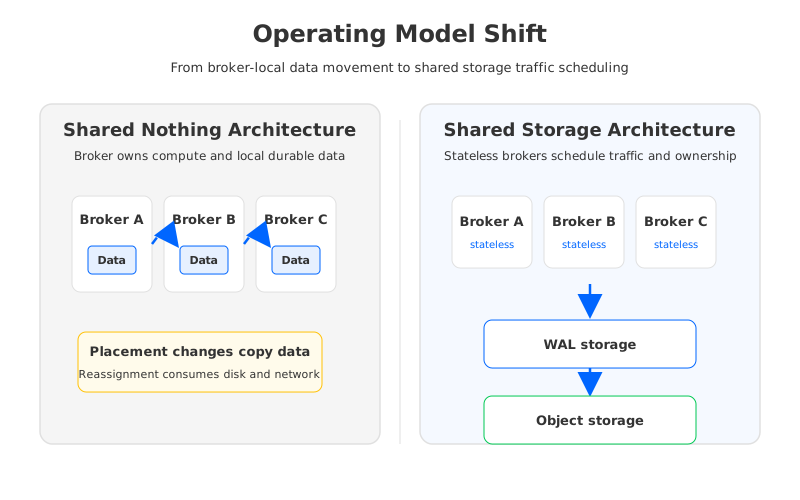
Traditional Kafka uses a Shared Nothing architecture. Each broker manages local storage, and replicated partitions maintain durability by keeping copies on different brokers. In a data center, that model made sense because the cluster controlled its own disks and internal network. In the cloud, the same mechanism can couple compute, storage, and network cost in ways that make FinOps reviews awkward.
The coupling shows up first in broker-local storage. A traffic-heavy topic needs enough local disk for retention, enough broker throughput for writes and reads, and enough replica capacity for failure handling. If the topic grows, the platform team may need larger disks or more brokers even when CPU is not the limiting resource. If the topic shrinks, the team may still keep headroom because removing capacity can trigger reassignment work and recovery risk.
The second pressure is data movement. With local storage, changing placement often means copying partition data from one broker to another. That work consumes disk I/O, network bandwidth, and operator attention. A placement plan that looks good on a whiteboard can become expensive when it requires moving large retained topics during a period when consumers still expect predictable latency.
The third pressure is cloud networking. AWS documents data transfer pricing as a separate part of EC2 pricing and distinguishes data transfer within the same Region from other paths. S3 pricing also separates storage, requests, retrieval, transfer, and management components. The exact rate depends on region, service, and path, so responsible FinOps work should validate pricing before publishing a savings model. The architectural lesson is stable: every replicated byte, replayed byte, and cross-boundary byte needs an owner.
3Architecture options and trade-offs
A neutral evaluation starts by separating tactical topic placement from architectural change. Tactical work is still valuable. Teams can review partition counts, leader distribution, retention policies, compression, producer locality, consumer group fan-out, and cluster isolation. These actions often reduce hotspots and improve accountability without changing the platform.
Tactical work reaches its limit when the largest cost drivers are created by the storage model itself. If brokers must carry local durable data, then a topic placement decision must reserve enough compute-adjacent storage for retention and enough network capacity for replication and reassignment. Tiered Storage can help with long-term historical data by moving older segments to remote storage, but it does not remove the need to reason about the hot local tier, partition leadership, and operational movement.
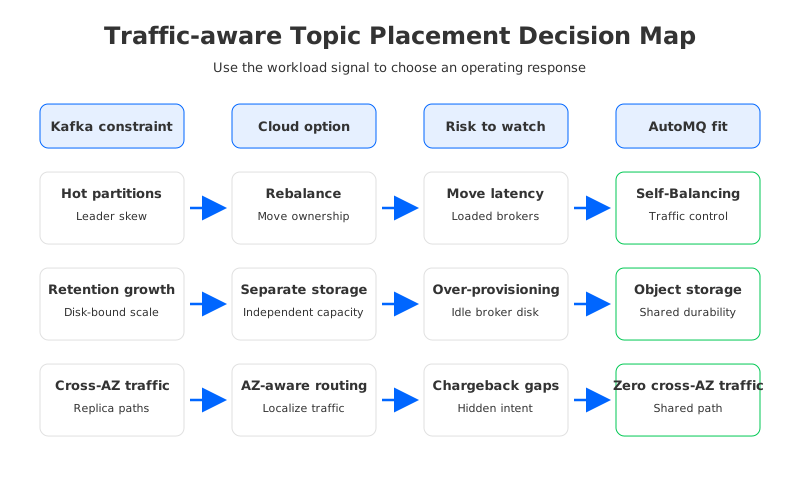
Use the following decision map to keep the evaluation grounded:
| Decision area | What to ask | Why it matters for FinOps |
|---|---|---|
| Compatibility | Will existing producers, consumers, Kafka Connect jobs, Kafka Streams apps, and admin tooling keep working? | Migration cost can outweigh infrastructure savings if applications need rewrites. |
| Traffic locality | Which producers and consumers share an AZ, VPC, region, or private network path with the cluster? | Placement without network visibility can hide the most expensive bytes. |
| Storage growth | Is the topic write-heavy, retention-heavy, replay-heavy, or all three? | Storage and replay economics differ from steady-state ingress. |
| Elasticity | Can the platform add or remove compute without copying large retained data? | Elasticity is a cost control only when it is operationally usable. |
| Governance | Who approves placement, retention, fan-out, and migration exceptions? | Chargeback needs policy ownership, not only metrics. |
| Recovery | What happens when a broker, AZ, or migration step fails? | A low-cost design that weakens rollback is not a FinOps win. |
This table also prevents a common mistake: treating "traffic-aware" as a broker scheduling problem only. Broker scheduling matters, but the decision has to include application placement, cloud network boundaries, storage lifecycle, and the team's tolerance for reassignment work.
4Evaluation checklist for platform teams
The most useful topic placement reviews are lightweight enough to run before a workload launches and specific enough to survive a budget review. A standard topic should not need a committee meeting, but a high-volume or high-retention topic should declare enough context that the platform team can reason about cost and reliability together.
Start with workload shape. Capture expected ingress, peak-to-average ratio, message size, key distribution risk, retention target, compaction needs, and replay behavior. Then capture consumption shape: number of consumer groups, expected fan-out, latency SLOs, and whether consumers live near the cluster or across network boundaries. Kafka's Consumer API and Consumer group model make parallel consumption productive, but they also make read paths multiply as more teams subscribe.
The next layer is operating policy. Decide whether this workload belongs on a shared platform cluster, a workload-specific cluster, a regulated cluster, or a migration target. Shared clusters improve utilization, but they require stronger admission rules. Dedicated clusters improve isolation, but they can create idle capacity. A FinOps review should name that trade-off instead of hiding it under a generic "platform standard."
Use this readiness scorecard before approving a topic placement change:
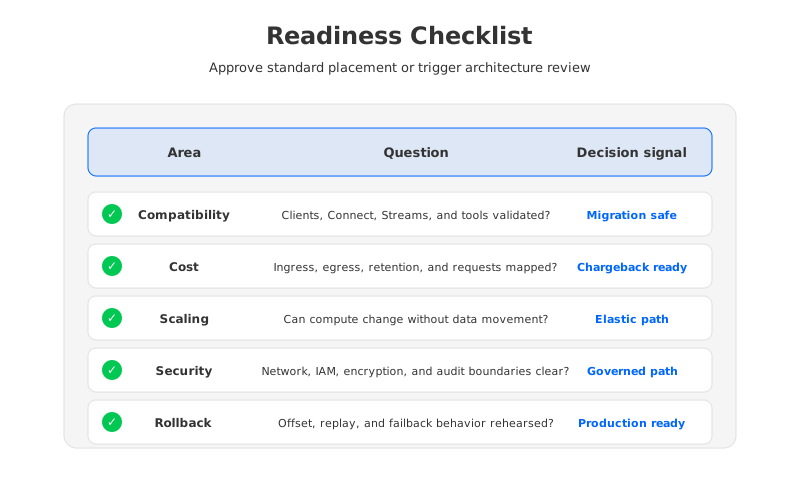
The scorecard is not meant to block every topic. It is meant to identify which topics need deeper architecture review. A low-volume operational topic with short retention can pass quickly. A high-volume customer event stream with long retention, multiple analytics consumers, and cross-region replay should trigger a more formal placement decision.
5How AutoMQ changes the operating model
Once the evaluation framework is in place, the architectural alternative becomes clearer. If the root constraint is that broker-local storage turns placement into data movement, then a Kafka-compatible platform with Shared Storage architecture changes the cost model at the right layer. AutoMQ is a cloud-native streaming platform that keeps Kafka protocol compatibility while replacing broker-local persistent storage with S3Stream and S3-compatible object storage.
In AutoMQ, brokers are stateless because durable data is stored through the shared storage layer instead of being bound to local broker disks. WAL (Write-Ahead Log) storage absorbs low-latency durable writes, while object storage becomes the primary storage layer. That separation means adding or removing broker compute is not the same as moving all retained partition data. The placement conversation shifts from "where is the data copied?" to "where should leadership and traffic run?"
That shift matters for traffic-aware topic placement in three practical ways. First, independent compute and storage scaling reduces the need to keep broker fleets large only because retained data is large. Second, seconds-level partition reassignment and Self-Balancing can address traffic skew without turning every rebalance into a data copy project. Third, AutoMQ's S3-based approach is designed to reduce Inter-Zone replica traffic and support Zero cross-AZ traffic patterns, which gives FinOps teams a cleaner way to attribute network cost drivers.
AutoMQ BYOC also changes the deployment boundary discussion. In BYOC (Bring Your Own Cloud), the control plane and data plane run in the customer's cloud account and VPC, which matters for teams that need cloud account control, network policy control, and governance alignment. AutoMQ Software covers private data center deployment, while AutoMQ Open Source is available for teams that want to validate the storage model with S3 WAL. The product choice still depends on latency needs, WAL type, compliance boundaries, and operational ownership; the key point is that the architecture gives platform teams a different set of trade-offs from broker-local Kafka.
This is where the FinOps framework becomes useful. AutoMQ is not a reason to skip workload classification. It is a reason to revisit assumptions that were inherited from Shared Nothing architecture: how much local disk must be provisioned, how long a rebalance must run, how much cross-AZ replication traffic is structurally required, and whether compute headroom has to scale with storage retention.
6A practical migration and governance path
The safest path is to treat traffic-aware topic placement as a staged operating model change. Begin with visibility, not migration. Map the top topics by ingress, egress, retention, replay, consumer group count, and network boundary. Then classify each topic by placement pressure: hotspot, retention-heavy, fan-out-heavy, regulated, or migration candidate. This gives finance and engineering the same object to discuss.
After classification, run a pilot on a workload where success is measurable and rollback is credible. A good candidate is important enough to expose real traffic patterns, but not so entangled that every application team must change at once. Validate Kafka client behavior, consumer group offsets, Kafka Connect jobs, observability, security controls, and failure handling. Compatibility should be tested as an application contract, not assumed from a platform label.
Finally, update governance. Make topic placement a standard part of workload intake, alongside retention, SLOs, ownership, and compliance. The policy does not need to be heavy. It should answer three questions before a topic becomes expensive: who owns the traffic, which architecture assumptions drive cost, and what migration or rollback path exists if those assumptions change?
If your team is evaluating a Kafka-compatible platform for traffic-aware topic placement and cloud Kafka TCO, start with your top five topics by traffic and retention. Then compare the broker-local operating model against a shared-storage model using the checklist above. To discuss how AutoMQ BYOC or AutoMQ Software would fit your environment, talk to an engineer through AutoMQ Cloud.
7FAQ
7.1What does traffic-aware topic placement mean in Kafka?
It means placing topics, partitions, leaders, and consuming workloads with awareness of write traffic, read fan-out, retention, network boundaries, failure domains, and operational ownership. It is broader than balancing partition counts across brokers.
7.2Is this the same as partition reassignment?
No. Partition reassignment is one operation used to change where partitions run. Traffic-aware topic placement is the policy and decision framework that determines whether reassignment, cluster isolation, consumer locality, architecture change, or workload governance is the right action.
7.3Does Tiered Storage solve topic placement cost?
Tiered Storage can reduce pressure from long-term historical data, but it does not remove every broker-local operating concern. Teams still need to evaluate hot data, partition leadership, local capacity, read fan-out, and reassignment behavior.
7.4When should a team evaluate AutoMQ?
Evaluate AutoMQ when Kafka cost optimization is constrained by broker-local storage, cross-AZ traffic, slow reassignment, or compute capacity that cannot scale independently from retained data. The strongest candidates are workloads where compatibility matters and cloud-native elasticity has measurable value.
7.5What should FinOps ask before approving a high-traffic topic?
Ask for expected ingress, retention, consumer group count, replay behavior, AZ or region boundaries, owner, SLO, compliance class, and rollback plan. Those inputs are enough to decide whether the topic can use a standard placement path or needs architecture review.
8References
- Apache Kafka 4.3 Documentation
- Apache Kafka Introduction: topics, partitions, replication, and APIs
- Apache Kafka Compatibility
- Apache Kafka Tiered Storage
- Apache Kafka Connect
- AutoMQ Shared Storage architecture
- AutoMQ technical advantages
- AutoMQ Continuous Self-Balancing
- AutoMQ Inter-Zone traffic overview
- AWS EC2 On-Demand Pricing: Data Transfer
- Amazon S3 Pricing


