
Table of Contents
Table of Contents
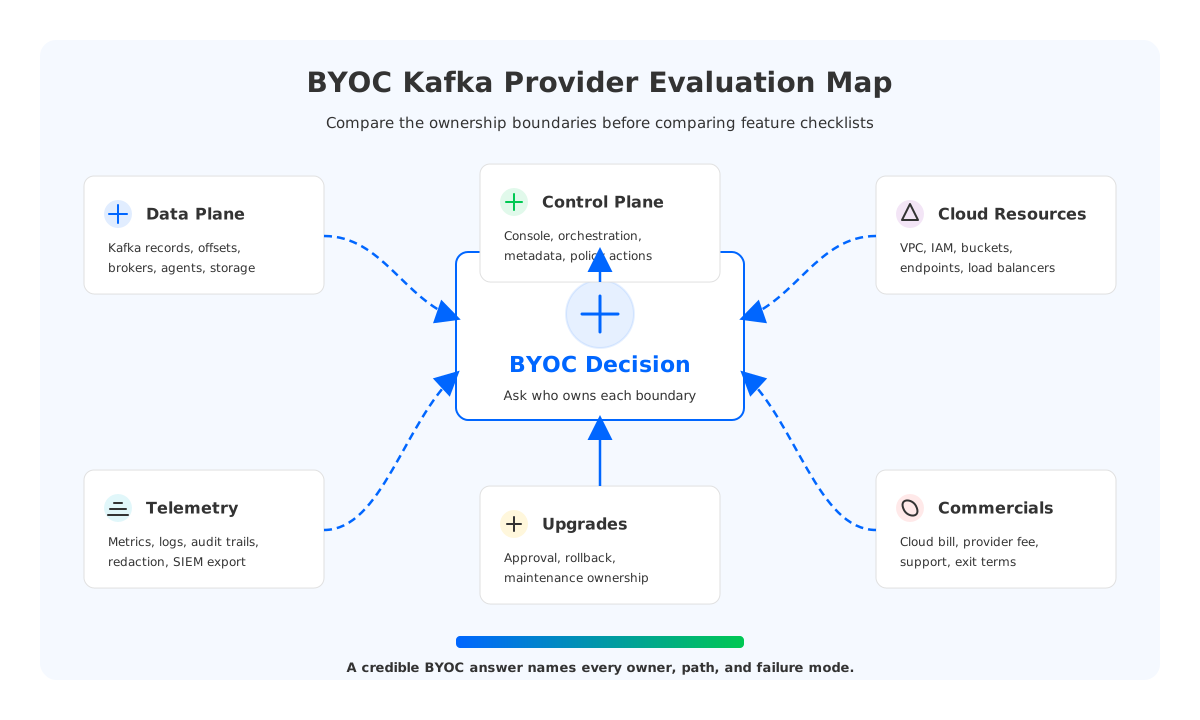
BYOC Kafka sounds like a simple purchasing category until the security review starts. The phrase usually means some part of the streaming system runs in your cloud account, but it does not tell you who creates the resources, who can reach the runtime, which metadata leaves the environment, where the control plane runs, or how upgrades happen. For enterprise architects and platform leaders, those details decide whether BYOC reduces risk or merely moves ambiguity into your cloud bill.
The right comparison is not a generic vendor matrix. BYOC Kafka providers use different architectures. Some run a vendor-managed control plane outside your account while a data plane, agent, broker fleet, or Kubernetes environment runs in your VPC or VNet. Some create and manage cloud resources for you. Some store durable Kafka data on object storage you own; others operate a more traditional broker architecture inside your environment.
A serious BYOC evaluation starts with the boundaries. Ask where Kafka records live, where operational metadata lives, which cloud identities are assumed, which logs and metrics flow to the provider, and what happens if the vendor control plane is unreachable. If the answers are vague, the deployment model is not yet ready for procurement.
1Why BYOC Kafka Provider Comparison Is Different
SaaS Kafka comparisons usually center on throughput tiers, feature coverage, SLAs, regions, connectors, and price. BYOC Kafka adds a second layer: the provider is now operating, coordinating, or supporting software that runs in a cloud environment your team is accountable for. The service may feel managed, but cloud IAM, network policy, regional placement, object storage lifecycle, and audit boundaries are still part of your risk model.
That is why two providers can both say "BYOC" and mean different things. Redpanda Cloud BYOC documentation, for example, describes a managed control-plane and data-plane architecture where the data plane lives in the customer's cloud, with Redpanda managing provisioning, monitoring, upgrades, and required resources. WarpStream documents a Kafka-compatible agent architecture in which agents run in the customer's environment and communicate with object storage and a hosted metadata/control plane. Aiven describes custom clouds in the customer's cloud provider account, including public and private deployment models and separate provider and cloud infrastructure billing. AutoMQ's BYOC documentation describes both control-plane and data-plane systems deployed in the user-defined network environment, with system metrics and logs collected through a maintenance bucket under customer authorization.
Those are not small implementation details. They determine which team must approve the deployment, what a regulator can inspect, how FinOps allocates cost, and what an on-call engineer can do during a Saturday incident.
For Kafka specifically, the hidden question is whether BYOC preserves Kafka's operational semantics while changing the ownership model. Enterprise teams usually need existing clients, Kafka Connect, schema governance, ACLs, consumer groups, offset behavior, and partition-level expectations to remain usable. If a provider changes those semantics, the migration becomes an application compatibility project.
2The Architecture Questions to Ask
The first architecture question is not "Where is the cluster?" It is "What is the cluster made of?" A BYOC Kafka provider may deploy brokers, agents, Kubernetes operators, load balancers, object storage buckets, metadata services, observability collectors, and upgrade controllers. Each component has a location, identity, network path, and failure mode.
Before accepting a provider's architecture diagram, ask which components run in your account, which run in the provider environment, where Kafka records are stored, what private or public network paths are required, and what happens to produce, fetch, commit, and admin operations if the external control plane is degraded. Also ask who owns DNS, certificates, load balancers, security groups, route tables, firewall rules, and endpoint services.
Resource creation is an early red flag area. Some providers intentionally create and manage infrastructure to preserve an SLA. That can be reasonable, but the permission boundary must be explicit. Redpanda's BYOC architecture documentation says IAM permissions allow its agent to access cloud provider APIs to create and manage cluster resources, following least privilege. Aiven's BYOC model describes custom clouds in the customer's cloud provider account and notes that cloud infrastructure and network traffic charges are the customer's responsibility. AutoMQ's AWS BYOC preparation documentation lists expected VPC, subnet, S3, endpoint, DNS, and NAT requirements; its environment overview states that the control plane and data plane are deployed in the user-defined network environment.
The practical procurement question is not "Does the vendor create resources?" It is "Can we see, constrain, tag, audit, and remove those resources without breaking our cloud governance model?"
3Security and Compliance Questions
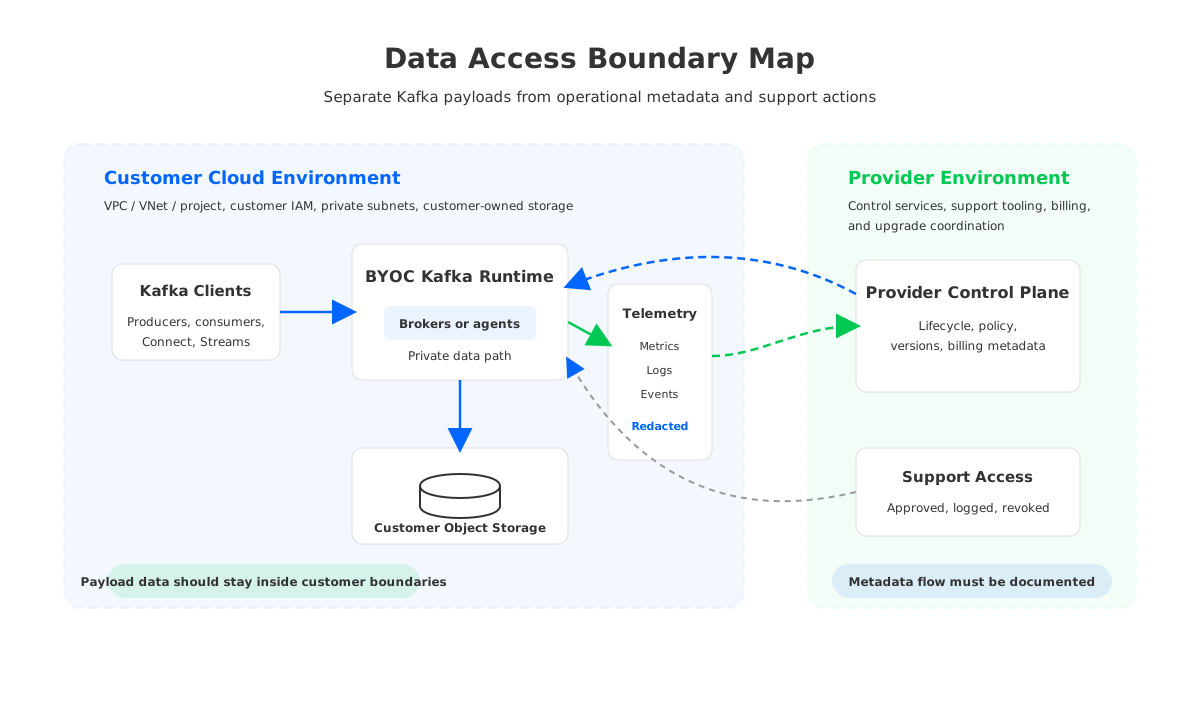
BYOC should not be treated as automatically more secure than SaaS. The strongest reason to choose BYOC is usually data residency, private networking, cloud-account ownership, or compliance alignment. The tradeoff is a shared responsibility model that must be written down before production.
Start with data access. Ask whether the provider can read raw Kafka records, compacted data files, schema payloads, topic data, connector payloads, or consumer offsets. Then ask whether the provider can read operational metadata such as topic names, principal names, ACL decisions, error messages, log snippets, metric labels, and IP addresses. Many security reviews focus on payload data, but metadata can still expose business-sensitive information when topic names include customer names, product codes, or regional identifiers.
The second security question is identity. A clean BYOC design should document every IAM role, service account, managed identity, token, and human-access path. It should also explain whether vendor access is persistent, just-in-time, customer-approved, read-only, write-capable, or break-glass only.
Networking deserves the same treatment. Private connectivity options are not interchangeable. AWS PrivateLink, Google Cloud Private Service Connect, Azure Private Link, VPC peering, transit gateways, NAT egress, and public IP allowlists create different blast radii and operational responsibilities. A provider that supports only public management endpoints may still be acceptable for a development environment, but production Kafka often sits near payment, telemetry, user activity, fraud, or operational data streams. The network path should match that sensitivity.
Neutral red flags include:
- The provider cannot identify which data or metadata leaves your environment.
- The deployment needs broad cloud permissions without a least-privilege policy.
- The architecture relies on manual firewall exceptions that are not captured as infrastructure as code.
- The vendor cannot explain how support access is approved, logged, and revoked.
- The provider's control plane region cannot be pinned or documented.
- Audit logs exist only in the vendor console and cannot be exported to your SIEM.
AutoMQ fits into this discussion as one example of a stricter boundary design: its BYOC documentation emphasizes customer-owned cloud resources, private data-plane access, object storage in the customer environment, and maintenance authorization for provider operations. The important evaluation point is not the brand name. It is whether a provider can make the data plane, object storage ownership, observability path, and access approvals concrete enough for your security team to sign.
4Pricing and Cost Transparency Questions
BYOC Kafka often looks cost-transparent because cloud resources are in your account. That is only half true. Your cloud bill exposes compute, storage, networking, NAT gateways, endpoints, load balancers, Kubernetes, disks, object storage, requests, and cross-zone traffic. The provider bill may separately include software subscription, managed operations, support, usage units, cluster fees, or premium networking features. Both bills matter.
Ask providers to separate the economics into three layers:
| Cost layer | What to request | Why it matters |
|---|---|---|
| Cloud infrastructure | Instance types, disks, buckets, request volume, load balancers, private endpoints, NAT, cross-zone traffic, backups | This is visible in your cloud bill and must fit tagging, chargeback, and cloud commit strategy. |
| Provider subscription | Software fee, managed service fee, support tier, cluster minimums, usage meters, overage policy | This controls commercial predictability and contract negotiation. |
| Operational labor | Upgrade approvals, incident participation, IAM reviews, quota management, network changes, compliance evidence | BYOC can reduce Kafka operations while increasing cloud governance work. |
Do not compare BYOC only against a self-managed Kafka cluster. Compare it against the business outcome you need: Kafka compatibility, private data ownership, operational relief, elasticity, compliance evidence, and predictable replay cost. Object-storage-backed designs, including AutoMQ and WarpStream-style architectures, change the model by moving durable log data into cloud object storage. That can be attractive when retention, replay, and elastic scaling matter, but it still needs workload-specific modeling.
Procurement should also ask about multi-region. Does the provider support active-active, active-passive, remote replicas, cluster linking, object-storage replication, or application-level failover? Which region hosts the control plane? Can the provider operate during a regional cloud outage? Do cross-region reads, object replication, or control-plane calls create extra egress? A low monthly quote can become misleading if disaster recovery is priced as an afterthought.
5Operations, Upgrades, and Incident Handling
Managed BYOC is not "no operations." It is redistributed operations. The provider may operate the Kafka runtime, but your platform team still owns cloud quotas, network routes, identity boundaries, budget alerts, and incident coordination with the cloud provider. A mature BYOC provider should have a written model for each of these.
Upgrade ownership is especially important. Ask who triggers upgrades, who approves maintenance windows, whether upgrades can be deferred, what versions are supported, whether rollbacks exist, and how client compatibility is tested. If the provider runs Kubernetes, ask who upgrades Kubernetes, node images, CNI components, and cloud controllers. If the provider runs agents or stateless brokers, ask how binaries are rolled and how capacity is maintained during rollout.
Observability is another place where provider architectures diverge. Some providers export metrics to the customer stack. Some collect metrics and logs into a provider console. Some use a customer-owned bucket or object storage path as the maintenance channel. None of these is inherently wrong, but the flow must be visible:
- Which metrics are collected, at what granularity, and where are they stored?
- Are logs redacted before leaving the environment?
- Can your SREs query broker, agent, topic, partition, consumer group, and network metrics without opening a vendor ticket?
- Can provider support troubleshoot without seeing payload data?
- Are alerts mirrored into your incident management system?
- Are support actions recorded in an audit trail?
Incident handling should be tested before the first critical workload moves. Run a tabletop exercise covering private endpoint misconfiguration, object storage throttling, failed upgrades, cloud quota exhaustion, regional control-plane impairment, consumer lag spikes, certificate expiry, and IAM policy drift. The goal is to learn whether the shared responsibility model is operationally real.
6Where AutoMQ Fits in a BYOC Kafka Shortlist
AutoMQ should enter a BYOC evaluation where the team wants Kafka compatibility, customer-owned cloud resources, object-storage-backed durability, elastic compute, and clear separation between data ownership and managed operations. In its BYOC materials, AutoMQ describes deployments where the control plane environment console and data plane Kafka service cluster run in the user's network environment, with Kafka data kept in the customer's cloud resources and private data-plane access. It also documents VPC, subnet, S3, endpoint, DNS, and Kubernetes considerations for AWS BYOC environments.
The architecture angle matters. If durable Kafka data sits in object storage that the customer owns, broker capacity can be treated more like elastic compute than a fixed storage estate. That is relevant for platform teams trying to reduce over-provisioning, avoid large partition reassignment projects, and align Kafka spend with cloud storage economics. The evaluation should still be evidence-based: confirm Kafka API compatibility for your clients, Connect workers, Streams applications, ACL model, observability requirements, and recovery runbooks.
AutoMQ is not the only BYOC option worth reviewing, and a credible shortlist may include Redpanda BYOC, WarpStream by Confluent, Aiven BYOC, or self-managed Kafka with a commercial support contract. The difference is the questionnaire. If a provider can answer the same questions with specific diagrams, permissions, logs, invoices, upgrade procedures, and failure behavior, it belongs in the discussion.
7BYOC Vendor Questionnaire
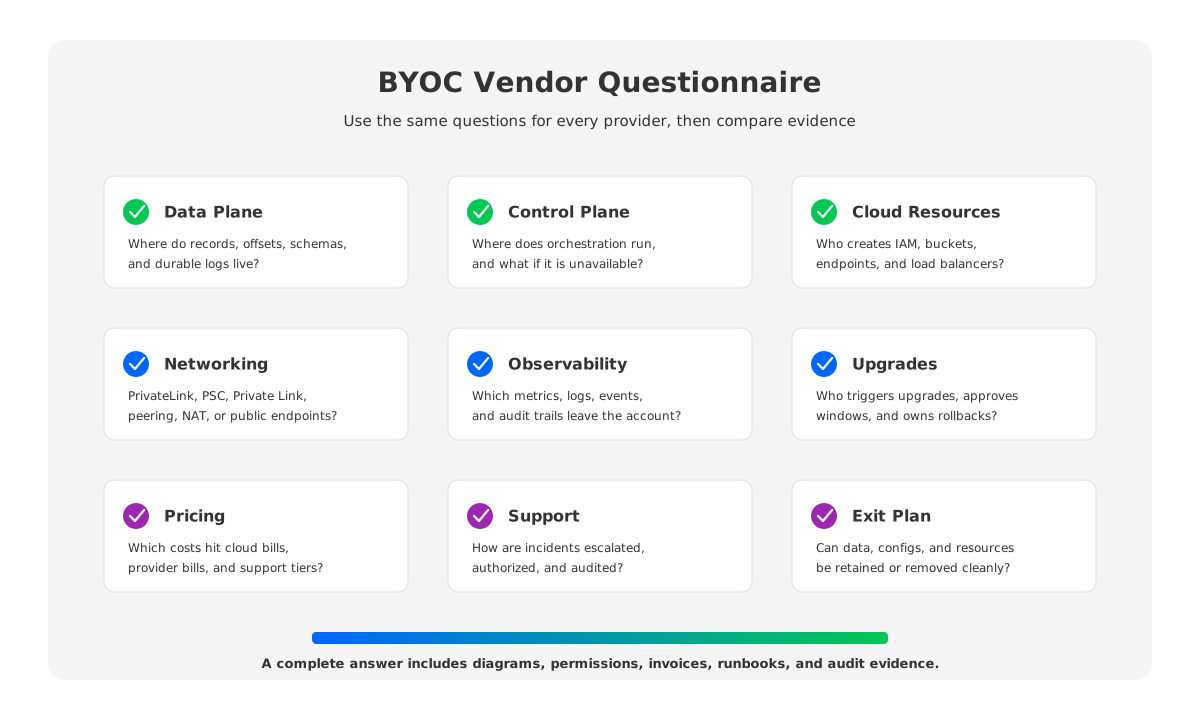
Use this questionnaire as a practical procurement artifact. It is intentionally specific because ambiguous answers become expensive after the first production incident.
| Area | Questions to ask |
|---|---|
| Data plane | Where do Kafka records, offsets, schemas, logs, and metadata live? Which components can read them? |
| Control plane | Where does the control plane run? Which region? What happens if it is unreachable? |
| Cloud resources | Who creates VPCs, subnets, buckets, disks, load balancers, endpoints, DNS records, and IAM roles? |
| Permissions | Can the provider supply a least-privilege policy and explain every action? Is access persistent or customer-approved? |
| Networking | Are PrivateLink, Private Service Connect, Azure Private Link, VPC peering, public endpoints, or NAT required? |
| Observability | Which metrics and logs leave the environment? Can logs be redacted? Can telemetry stay in customer storage? |
| Pricing | Which costs appear on the cloud bill, and which appear on the provider bill? Are support and private networking included? |
| Upgrades | Who triggers upgrades? Can they be deferred? Are rollbacks supported? How are client compatibility risks handled? |
| Multi-region | Is DR built into the product, a separate feature, or an application-level pattern? What are the egress implications? |
| Support | What is the incident escalation path? Who talks to the cloud provider? Are support actions audited? |
| Exit | Can data be retained in open formats or customer buckets? What happens to resources and metadata at contract end? |
The final decision should be boring in the best way: the chosen provider's answers should map cleanly to your security controls, cloud governance, Kafka compatibility tests, and cost model. BYOC Kafka is valuable when it makes ownership explicit. It is risky when it turns ownership into a slogan.
8References
- AutoMQ Documentation: Manage Environments Overview
- AutoMQ Documentation: Prepare VPC for AWS BYOC
- AutoMQ Product: Bring Your Own Cloud
- Confluent: What is Bring Your Own Cloud?
- Confluent Documentation: Kafka Cluster Types in Confluent Cloud
- WarpStream Documentation: Architecture
- WarpStream Documentation: Security and Privacy Considerations
- Redpanda Cloud Documentation: BYOC
- Redpanda Cloud Documentation: BYOC Architecture
- Aiven Documentation: Bring Your Own Cloud
- AWS Documentation: AWS PrivateLink
- Google Cloud Documentation: Private Service Connect
- Microsoft Azure Documentation: Azure Private Link
9FAQ
9.1What is a BYOC Kafka provider?
A BYOC Kafka provider delivers managed Kafka or Kafka-compatible streaming software that runs partly or fully in the customer's cloud account. The exact boundary varies by provider, so teams should verify where the data plane, control plane, object storage, logs, metrics, and support access paths live.
9.2Is BYOC Kafka always more secure than SaaS Kafka?
No. BYOC can improve data residency, private networking, and cloud-account control, but it also creates shared responsibility for IAM, networking, resource governance, and incident coordination. Security depends on the provider's architecture and your cloud controls.
9.3What should security teams ask first?
Start with data and identity boundaries: who can read Kafka records, which metadata leaves the environment, what IAM roles are required, whether provider access is persistent or customer-approved, and how all support actions are audited.
9.4How should FinOps evaluate BYOC Kafka pricing?
Model both invoices. BYOC usually creates cloud infrastructure charges in your account plus a provider subscription or managed service fee. Include compute, storage, object storage requests, private endpoints, NAT, cross-zone traffic, support tiers, and operational labor.
9.5Where does AutoMQ fit in a BYOC Kafka comparison?
AutoMQ fits when the evaluation prioritizes Kafka compatibility, customer-owned cloud resources, private data-plane access, object-storage-backed durability, elasticity, and clear observability and maintenance boundaries. It should be compared with the same questionnaire used for every provider.


