
Table of Contents
Table of Contents
Searching for Confluent Cloud competitors usually means the team is past casual research. Someone has already accepted that Kafka, or a Kafka-compatible platform, is part of the architecture. The real question is narrower and more expensive: which vendor belongs on the shortlist before contracts, migration work, security review, and platform ownership all start to harden.
That is why a generic "top competitors" list is a weak buying tool. It puts very different products next to each other as if they answer the same decision. A fully managed Kafka SaaS, a cloud-provider service, a Kafka-compatible engine, and a shared-storage BYOC platform can all be legitimate options, but they trade off control, cost structure, operational responsibility, and compatibility in different ways.
The better approach is to score the decision before ranking the vendors. Confluent Cloud is a fully managed, cloud-native data streaming platform powered by Apache Kafka, with adjacent capabilities such as connectors, Schema Registry, governance, and Flink. A useful competitor evaluation should start from that scope, then ask which parts of the platform you truly need, which parts you already operate elsewhere, and which constraints matter enough to change the shortlist.
1Why Competitor Lists Are Not Enough For Kafka Platforms
Kafka platform selection is not like choosing a single developer tool. The platform sits between producers, consumers, governance workflows, data lake integrations, network boundaries, and incident response. A vendor switch can touch client configurations, private connectivity, schema practices, replication strategy, procurement terms, and the operating model of the platform team.
Top-list articles tend to flatten those issues into brand comparisons. That makes the research feel fast, but it hides the decisions that cause late-stage surprises:
- A service can be excellent for developer velocity while still failing a data-residency or network-control requirement.
- A platform can be Kafka-compatible for common producer and consumer paths while requiring deeper validation for transactions, admin APIs, quotas, or ecosystem tools.
- A pricing model can look clean at the entry point while becoming harder to predict when retention, replication, connector tasks, private networking, and cross-region traffic are included.
- A BYOC model can satisfy data-control requirements while adding shared-responsibility questions that procurement and security need to understand.
The goal is not to prove that one category is universally better. The goal is to prevent a false shortlist. If your team wants an integrated streaming suite with managed connectors and governance, the evaluation will look different from a team that already owns the surrounding platform and mainly wants Kafka-compatible storage economics inside its cloud account.
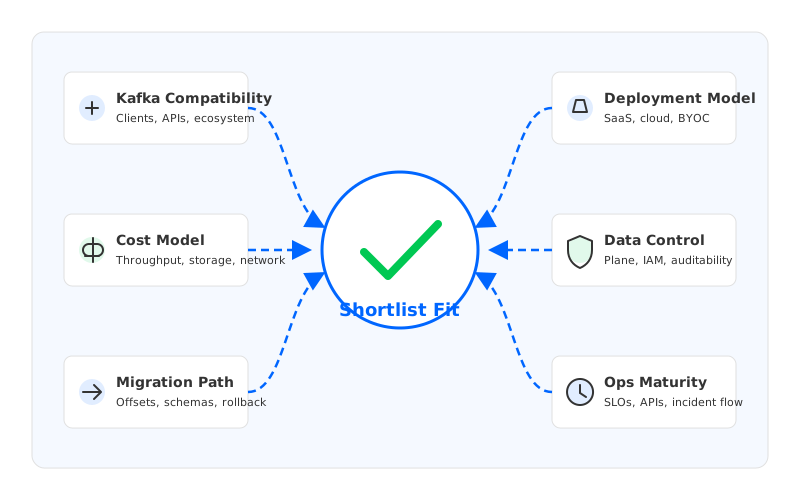
2The Six Criteria That Matter
The strongest shortlist starts with six criteria. Each one should be scored against the workload you are actually moving, not against a demo cluster.
| Criterion | What to Validate | Why It Changes The Shortlist |
|---|---|---|
| Kafka compatibility | Client protocol, admin operations, transactions, quotas, Connect, Streams, Schema Registry, and monitoring tools | Compatibility gaps often appear after application teams begin migration testing |
| Deployment model | SaaS, cloud-provider managed service, BYOC, self-managed, or software in your Kubernetes/VPC boundary | The deployment boundary decides data control, network design, support responsibility, and procurement path |
| Cost model | Throughput, storage, retention, connectors, private networking, replication, support, and committed spend | Kafka cost is rarely one line item; it is a system of workload and architecture choices |
| Data control | Data plane location, metadata location, control-plane access, encryption, IAM, audit logs, and maintenance access | Security teams care where data and authority live, not only who operates the service |
| Migration path | MirrorMaker, Cluster Linking, dual-write, topic configuration, ACLs, schemas, consumer offsets, and rollback | Migration risk can outweigh platform benefits if cutover cannot be staged safely |
| Operations maturity | Observability, scaling behavior, upgrades, incident support, runbooks, Terraform/API coverage, and SLO ownership | A cheaper platform is not cheaper if the platform team inherits fragile operations |
Compatibility deserves special treatment because the word can mean several things. For a prototype, producer and consumer API compatibility may be enough. For an enterprise migration, you need a matrix that includes client libraries, transactional workloads, Kafka Connect behavior, schema governance, security integrations, quota controls, and the admin APIs used by your automation.
Cost also needs a disciplined definition. Kafka spend usually includes compute, durable storage, replicated storage, retention, private connectivity, inter-zone or inter-region movement, connector runtime, observability, and support. Some platforms make these costs visible as separate cloud bills; others bundle them into platform pricing. Neither model is automatically better, but the finance team needs a normalized workload model before comparing offers.
3Common Types Of Confluent Competitors
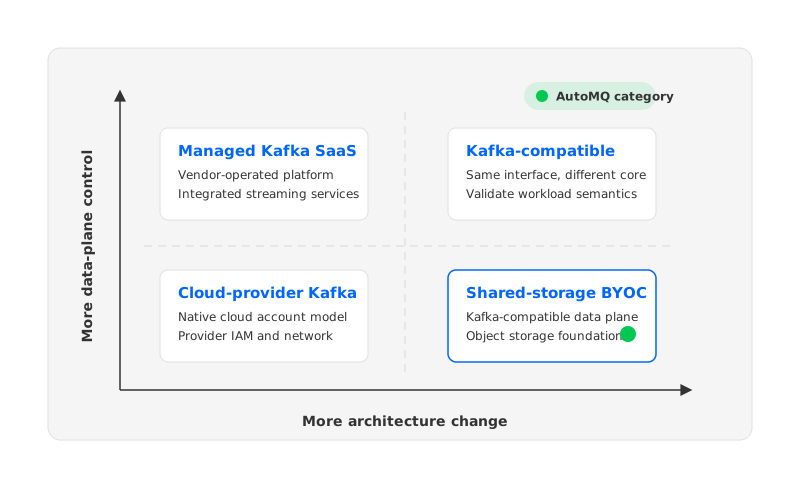
Vendor names are useful only after the category is clear. A practical longlist should group options by operating model first, then compare vendors inside each group.
3.1Managed Kafka SaaS
Managed Kafka SaaS is closest to the Confluent Cloud buying motion. The vendor operates the service, exposes a cloud console and APIs, and often packages surrounding services such as connectors, schema management, stream processing, governance, or monitoring. Confluent Cloud itself is the reference point for this category, and Redpanda Cloud also offers managed deployment options including serverless, dedicated, and BYOC modes according to its documentation.
This category is usually attractive when developer velocity and operational offload matter more than owning every infrastructure boundary. The evaluation should focus on platform completeness, cloud and region availability, private networking, support model, feature maturity, and how the vendor handles surrounding services like connectors and schema workflows.
The risk is assuming SaaS always removes complexity. It removes many broker-level tasks, but it can introduce network design, IAM, data movement, billing attribution, and governance integration work. For procurement, the key question is whether the vendor's managed boundary matches your internal control model.
3.2Cloud-Provider Kafka
Cloud-provider Kafka services fit teams that want Kafka inside an existing cloud operating model. Amazon MSK, for example, is AWS's managed service for building and running Apache Kafka applications, and MSK Serverless is documented as a cluster type that automatically provisions and scales capacity. MSK Connect extends the model to managed Kafka Connect workloads.
The appeal is organizational as much as technical. The platform team can use existing cloud accounts, IAM patterns, network constructs, billing workflows, and procurement channels. That can simplify adoption for AWS-standardized teams, especially when the surrounding data platform already lives in the same cloud.
The evaluation should not stop at "managed by the cloud provider." Ask how much Kafka expertise your team still needs, how cluster sizing and scaling work, how connector operations are billed and isolated, how private connectivity is designed, and what happens when multi-cloud or cloud-exit requirements appear. Cloud-provider fit is strongest when the target operating model is already cloud-provider native.
3.3Kafka-Compatible Alternatives
Kafka-compatible alternatives keep the Kafka ecosystem as the interface while changing parts of the implementation. Redpanda documents Kafka client compatibility for Kafka versions 0.11 and later, with specific exceptions. WarpStream documents itself as a diskless, Apache Kafka-compatible streaming platform built directly on cloud object stores, and also publishes a protocol and feature support page that teams should inspect before assuming full workload equivalence.
This category is attractive when the team wants to preserve Kafka-facing application contracts while improving operational or architectural properties. The right validation is not a logo-level "Kafka compatible" claim. It is a workload test: your clients, your message sizes, your transactions or idempotent producers, your ACL model, your retention pattern, your monitoring stack, and your failure drills.
Kafka compatibility can be enough to make migration practical, but the depth of compatibility determines how much application and platform behavior must be retested. Treat every compatibility statement as an invitation to build a test plan, not as a substitute for one.
3.4Kafka-Compatible Shared-Storage Platforms
Shared-storage platforms change the storage architecture more directly. Instead of treating broker-local disks as the durable center of the system, they move persistent stream data to shared cloud storage or object storage while keeping a Kafka-compatible interface. WarpStream is one example of a diskless object-store design. AutoMQ fits this category as a Kafka-compatible shared-storage BYOC platform that uses object storage and stateless brokers.
This category becomes interesting when the team cares about cost structure, elasticity, and data control. If durable data lives in object storage and brokers are less stateful, scaling and failure recovery can be reasoned about differently from traditional Kafka storage tied to broker-local disks. The trade-off is that architecture matters: latency path, write-ahead logging, cache behavior, metadata placement, and cloud-storage dependency all need technical review.
AutoMQ should appear on the shortlist when the buying question is not only "who can run Kafka for us?" but "can we keep Kafka compatibility while changing the storage economics and keeping the data plane in our cloud environment?" That is a narrower position than a generic Confluent replacement claim, and it is more useful for platform teams that need BYOC, cost transparency, and control over where data resides.
4Where AutoMQ Fits
AutoMQ is not best understood as another managed Kafka list item. Its useful category is Kafka-compatible shared-storage BYOC. The platform keeps the Kafka protocol and ecosystem as the application-facing contract, while redesigning the storage layer around object storage and stateless brokers. AutoMQ documentation describes the system as fully Kafka-compatible and explains that broker nodes become stateless by offloading Kafka's storage layer to cloud storage through S3Stream.
That positioning matters for teams evaluating Confluent Cloud competitors because it changes the decision axis. Confluent Cloud is strong when the desired outcome is a vendor-operated streaming platform with integrated services. AutoMQ is relevant when the desired outcome is Kafka compatibility inside a customer-controlled cloud boundary, with object storage as the durable storage foundation and a managed BYOC experience.
The right AutoMQ evaluation should be precise:
- Put it in the shared-storage or diskless Kafka-compatible category, not in a generic SaaS-only bucket.
- Validate client and ecosystem compatibility against your real workloads, including Connect, Streams, schemas, admin automation, ACLs, and observability integrations.
- Model cost around your retention, write throughput, read fanout, availability-zone design, and cloud-storage usage instead of relying on a single headline number.
- Review the BYOC boundary with security: data plane, metadata, control-plane access, IAM, maintenance authorization, auditability, and network paths.
This is where a framework beats a ranking. A team that wants a complete vendor-operated streaming suite may shortlist differently from a team optimizing for data sovereignty and cloud-native storage economics. Both teams can be rational. They are solving different problems.
5Shortlist Scoring Template
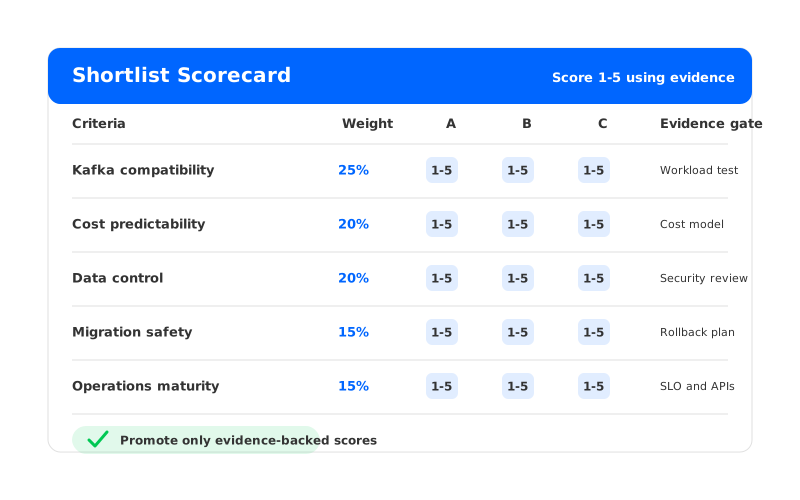
A shortlist should have no more than three to five serious candidates. More than that usually means the team has not decided what matters. Use weighted scoring to force that decision early.
| Criterion | Suggested Weight | Candidate A | Candidate B | Candidate C | Evidence Required |
|---|---|---|---|---|---|
| Kafka compatibility | 25% | Results from client, admin API, transaction, Connect, schema, and monitoring tests | |||
| Cost predictability | 20% | Normalized workload model with retention, throughput, networking, support, and connectors | |||
| Data control | 20% | Data-plane location, metadata location, IAM, encryption, audit logs, maintenance model | |||
| Migration safety | 15% | Cutover plan, offset handling, rollback plan, schema and ACL migration, dual-run duration | |||
| Operations maturity | 15% | SLOs, observability, upgrades, incident response, Terraform/API coverage, support process | |||
| Strategic fit | 5% | Cloud strategy, vendor consolidation, procurement path, roadmap alignment |
Scores should be evidence-based: 1 means the criterion is mostly unproven, 3 means it works with caveats, and 5 means the vendor has passed your workload-specific validation. Do not let a strong sales demo compensate for a missing migration test. Kafka platforms fail late when teams score narratives instead of evidence.
A useful shortlist review meeting has three artifacts: the scoring table, the workload model, and the migration risk register. The scoring table shows the decision. The workload model explains the cost and performance assumptions. The risk register keeps unresolved items visible, such as private connectivity, quota behavior, connector isolation, offset migration, or data-residency exceptions.
6References
- Confluent Cloud documentation
- Confluent Cloud overview
- Confluent Cloud managed connectors
- Amazon MSK documentation
- What is MSK Serverless?
- Understand MSK Connect
- Redpanda Cloud overview
- Redpanda Kafka compatibility
- WarpStream introduction
- WarpStream protocol and feature support
- AutoMQ stateless broker documentation
- AutoMQ BYOC product page
7FAQ
7.1What is the best Confluent Cloud competitor?
There is no single best competitor across all Kafka workloads. Confluent Cloud alternatives should be evaluated by category: managed Kafka SaaS, cloud-provider Kafka, Kafka-compatible alternatives, and Kafka-compatible shared-storage platforms. The best option depends on whether your priority is integrated platform services, cloud-provider alignment, compatibility with lower operational burden, BYOC control, or storage cost structure.
7.2Is Amazon MSK a Confluent Cloud alternative?
Amazon MSK can be an alternative for teams standardized on AWS that want a managed Apache Kafka service inside the AWS operating model. The evaluation should include cluster type, scaling behavior, Kafka Connect requirements, private networking, operational ownership, and the degree of AWS-specific coupling your team is willing to accept.
7.3Is Redpanda a Kafka replacement or a Kafka-compatible platform?
Redpanda positions itself as Kafka-compatible and documents client compatibility along with exceptions. That makes it a candidate for teams that want to preserve Kafka-facing application behavior while evaluating a different implementation and managed cloud experience. As with any Kafka-compatible platform, validate your own clients, admin workflows, transactions, schemas, and observability stack.
7.4How is AutoMQ different from a typical managed Kafka service?
AutoMQ fits the Kafka-compatible shared-storage BYOC category. It keeps Kafka compatibility while using object storage and stateless brokers, with deployment designed for teams that want the data plane in their cloud environment. That makes it relevant when cost structure, elasticity, and data control are central shortlist criteria.
7.5Should a shortlist include both SaaS and BYOC options?
Yes, if the team has not yet decided the operating model. Comparing SaaS and BYOC options can clarify whether the real constraint is operational offload, data control, procurement path, or cost predictability. Once that constraint is clear, the shortlist should narrow to vendors that match the chosen operating model.
7.6What proof should vendors provide before final selection?
Ask for workload-specific evidence: compatibility test results, a normalized cost model, private networking design, data-control documentation, migration plan, rollback plan, SLO and support terms, Terraform or API examples, and incident-response procedures. A strong shortlist is built on evidence your platform team can reproduce, not on feature-page claims alone.


