
Table of Contents
Table of Contents
Kafka Connect usually enters a platform quietly. One team needs a database source connector, another adds an object-storage sink, and a third wires a warehouse or search index into the same Kafka estate. The first invoice often looks reasonable because it covers a small number of connectors and modest throughput. The surprise arrives later, after CDC streams, retry paths, and higher availability requirements turn connector spend into a recurring platform line item.
The uncomfortable part is that the public price unit rarely tells the whole story. A managed connector may be billed by provisioned capacity, task-hours, connector-hours, transferred data, or a service-specific abstraction. The workload then adds its own multipliers: task parallelism, worker capacity, private networking, source database load, sink API limits, support tier, and engineering time. Treating managed Kafka Connect pricing as a per-connector sticker price is how teams miss the number that lands in the budget.
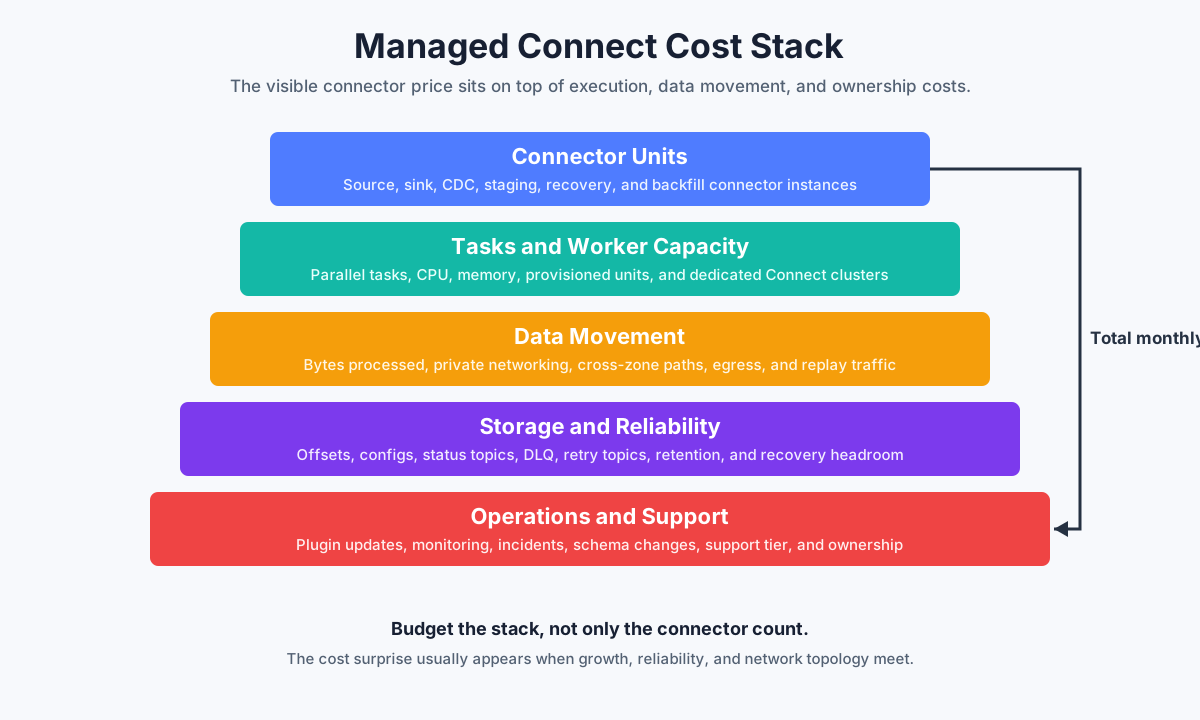
A better estimate starts with the full cost stack. The connector is the visible unit, but the bill usually reflects worker execution, data movement, platform dependencies, and operational ownership. Managed services reduce infrastructure work, yet each connector still has production behavior to budget.
1Why Connector Cost Grows With Platform Adoption
Kafka Connect standardizes data movement between Kafka and external systems. That is valuable because teams avoid one-off ingestion and export services for every database, storage bucket, SaaS API, or analytics sink. In a shared data platform, though, standardization also lowers the barrier to adding more pipelines. The same convenience that makes the first connector attractive can make the fiftieth connector hard to budget.
The growth pattern is rarely linear. A business domain may need a production source, a staging source, an analytics sink, a dead-letter path, and a recovery connector for backfills. CDC pipelines add pressure because each source table, database, or capture job can carry different throughput and recovery requirements. If the service prices by provisioned capacity, idle connectors can still cost money. If it prices by data transfer, a hot backfill can change the monthly number without any change in connector count.
The hidden driver is ownership. Managed Kafka Connect hides more worker machinery, which is the point, but the economic trade remains. Someone still pays for capacity, networking, storage, observability, support, and the reliability envelope around source and sink systems.
2The Main Managed Kafka Connect Pricing Drivers
The first pass of a cost model should separate billable units from workload multipliers. Billable units are what the vendor invoice uses. Workload multipliers are what force those units to grow. The distinction matters because two connectors with the same name can have very different cost profiles when one moves a few small events per minute and the other tails a busy transactional database.
| Cost driver | What to estimate | Why it changes the bill |
|---|---|---|
| Connector count | Production, staging, recovery, and temporary backfill connectors | Each configured connector may create a baseline charge or capacity reservation |
| Task parallelism | tasks.max, partition count, source splits, and sink concurrency | More tasks can require more worker capacity or task-hours |
| Throughput | Bytes in, bytes out, records per second, and peak bursts | Data processing and data transfer charges may scale with volume |
| Worker capacity | CPU, memory, provisioned capacity units, or dedicated Connect clusters | Heavy transforms, converters, and CDC parsing need more execution headroom |
| Networking | Private links, NAT gateways, cross-zone traffic, cross-region paths, and egress | Connectors often sit between systems with different network billing paths |
| Storage and state | Offset, config, status, DLQ, retry, staging, and sink-side files | Reliability features create persistent data that must be retained and monitored |
| Operations | On-call, upgrades, plugin validation, schema changes, incident response | Managed execution reduces infrastructure work but does not remove pipeline ownership |
This table explains why a quote based only on "number of connectors" is incomplete. Connector count is easy to inventory, but task count and throughput determine whether the connector can keep up. A CDC source can need more memory, more network headroom, and tighter monitoring because lag translates directly into stale downstream data.
Apache Kafka's Connect model reinforces this point. Connectors define the integration, tasks perform the parallel work, and workers run those tasks in standalone or distributed mode. A managed service may abstract the workers away, but it cannot abstract away the fact that parallelism consumes resources.
3A Practical Managed Connect Cost Formula
The most useful formula is not a universal price. Managed services differ too much for that, and exact prices can change by region, cloud, marketplace, contract, and connector type. The useful formula is a worksheet that forces every cost-bearing assumption into the open:
Monthly connector TCO =
  managed connector execution
+ worker or capacity reservation
+ Kafka cluster impact
+ network and data transfer
+ storage, retry, and DLQ retention
+ observability and support
+ engineering ownership
+ migration, testing, and backfill effort
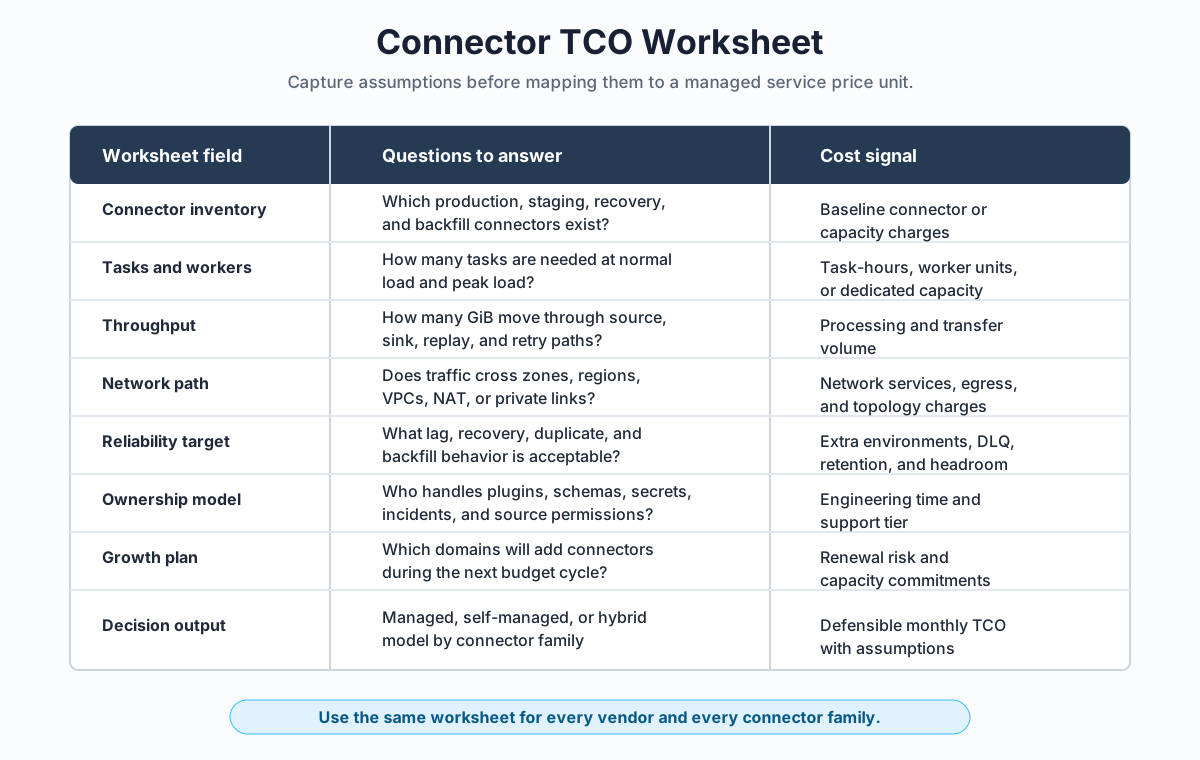
Start with steady-state production, then add non-production and operational scenarios. Many teams estimate the happy path and forget staging connectors, replay connectors, canary connectors, and short-lived backfill jobs that run hot for a few days. These may not dominate every month, but they shape the capacity and support model.
For each connector family, capture the assumptions in the same format:
- Runtime profile: How many hours per month does the connector run, and does it scale to zero when idle?
- Parallelism profile: What task count is needed at normal load and peak load? If the source or sink throttles, more worker capacity may not reduce lag.
- Data profile: How many GiB move through the connector in each direction? Include backfills, reprocessing, and retry traffic.
- Reliability profile: What lag, recovery time, and duplicate-handling behavior is acceptable?
- Ownership profile: Which team handles plugin updates, schema compatibility, source permissions, sink failures, and incident response?
This worksheet keeps the conversation grounded. If a managed service looks expensive, the team can see whether the price comes from baseline connector execution, network topology, dedicated capacity, or high-volume workload behavior. If self-managed Kafka Connect looks lower cost, the same worksheet exposes the engineering work that may have been left outside the infrastructure estimate.
4Self-Managed vs Managed Connect TCO
Self-managed Kafka Connect is attractive when a platform team already has strong Kubernetes, Kafka, security, and observability practices. The direct infrastructure cost is visible and controllable. You can place workers near the Kafka cluster, manage plugins, control rollout cadence, and reserve capacity. For stable connector estates with predictable volume, that control can be valuable.
The tradeoff is that self-managed cost does not end at compute. The team must maintain connector images, patch dependencies, test plugin compatibility, operate distributed workers, protect internal topics, monitor task failures, manage secrets, and recover offset state. During incidents, the organization owns the full path from source to sink.
Managed Kafka Connect shifts much of the worker lifecycle to the provider. Amazon MSK Connect describes fully managed Kafka Connect workloads with automatic scaling and charges tied to running connectors. Confluent Cloud offers fully managed connectors and documents cases where connectors run on dedicated Connect clusters for dedicated Kafka environments. These models can reduce operations work, but they also introduce service-specific billing units and limits.
The right comparison is not "managed connector price versus a few worker pods." It is managed connector TCO versus the full cost of running a reliable connector platform:
| Decision area | Self-managed Connect | Managed Connect |
|---|---|---|
| Infrastructure control | Highest control over workers, plugins, placement, and rollout timing | Provider abstracts worker lifecycle and may constrain configuration choices |
| Cost visibility | Clear compute and storage line items, but labor is easy to undercount | Invoice is clearer, but service units can hide workload multipliers |
| Reliability burden | Platform team owns worker availability, patching, offset topics, and recovery | Provider owns more execution infrastructure; application and pipeline correctness remain yours |
| Scaling behavior | Tuned by your team through workers, tasks, and resource limits | Governed by provider scaling model, connector limits, and capacity settings |
| Migration risk | Flexible, but every dependency must be tested by the team | Faster path for supported connectors, with provider-specific constraints to validate |
The table is a budgeting discipline, not a universal recommendation. A team with five low-volume connectors and limited Kafka operations capacity may benefit from managed execution. A team with hundreds of specialized connectors, strict network placement rules, and deep Connect expertise may prefer self-management or a hybrid model. The expensive mistake is choosing either path without pricing the reliability work.
5Connector Migration and Cost Review Checklist
A connector cost review should happen before renewal, before a major CDC expansion, and before a Kafka platform migration. The review is a reliability check as much as a FinOps exercise, because the most costly connectors are often the ones that become business-critical after adoption spreads.
Use this checklist to expose both spend and operational risk:
- Inventory every connector instance. Include development, staging, disaster recovery, paused connectors, and temporary jobs.
- Group by business function. A domain may own several source and sink connectors, and grouping makes retirement or consolidation easier.
- Record task and throughput assumptions. Capture tasks, peak throughput, average throughput, lag target, and backfill requirements.
- Map network paths. Note whether traffic crosses zones, regions, VPC boundaries, PrivateLink endpoints, NAT gateways, or public egress. Connector cost surprises often sit in network line items rather than connector line items.
- Validate source and sink limits. If an external system throttles, more connector capacity may raise cost without reducing lag.
- Price operational scenarios. Include upgrades, schema changes, connector restarts, replay jobs, DLQ retention, and incident response. These are normal platform costs, not exceptional events.
- Decide what to retire. Some connectors exist because they were easier to create than to govern. Cost review is a good time to remove duplicate pipelines and stale environments.
The checklist also helps with vendor comparison. Instead of asking which managed Kafka Connect service is lower cost in the abstract, ask how each service prices your actual connector estate. A task-heavy CDC deployment and a low-volume SaaS integration can land in different parts of a provider's pricing model.
6Where AutoMQ Fits in a Broader Kafka Cost Strategy
Connector cost should be reviewed together with Kafka platform cost because connectors amplify the cluster underneath them. A source connector writes into Kafka, a sink connector reads from Kafka, and retry or DLQ flows add topics, retention, and network movement. If the cluster is already constrained by broker storage, partition placement, replication, or manual scaling, adding more connectors can make the platform cost problem larger.
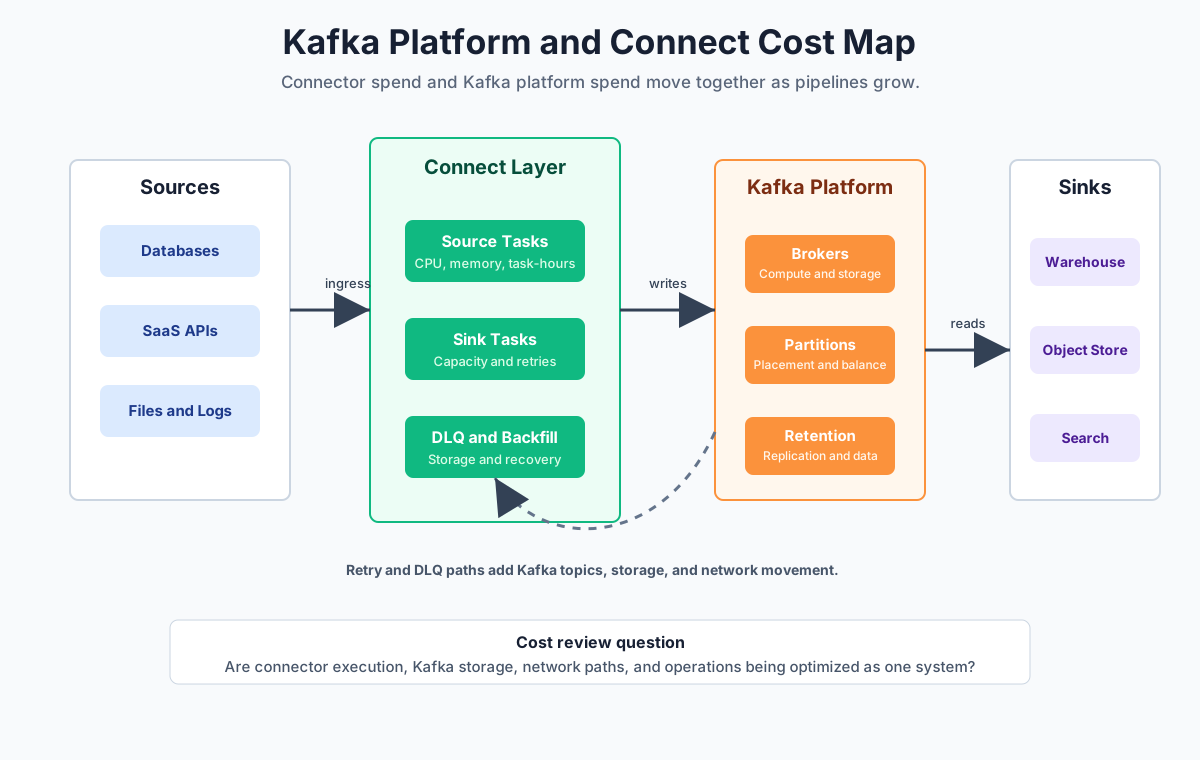
This is where a broader architecture review matters. The goal is to ask whether the Kafka platform and the connector layer are being optimized as one system. A managed connector may reduce worker operations while the Kafka cluster still requires capacity planning, local disk provisioning, replication overhead, and manual balancing.
AutoMQ belongs in that broader conversation when teams want Kafka-compatible streaming with BYOC control and cloud-native operations. AutoMQ BYOC runs in the customer's cloud environment, keeps the Kafka API surface familiar, and uses an object-storage-based architecture to reduce the operational weight of broker storage and scaling. For connector-heavy estates, that matters because the connector layer is only as predictable as the Kafka platform it depends on.
If you are already reviewing managed Kafka Connect pricing, review the Kafka cluster that every connector depends on. Connector spend may be the visible trigger, but durable savings often come from simplifying the whole streaming platform: fewer manual scaling decisions, clearer workload isolation, more predictable storage behavior, and better pipeline governance.
7References
- Apache Kafka documentation: Kafka Connect
- Amazon MSK Connect
- Amazon MSK pricing
- Confluent Cloud managed connectors documentation
- Confluent Cloud billing documentation
- AutoMQ BYOC product page
- AutoMQ documentation
8FAQ
8.1What is the biggest driver of managed Kafka Connect pricing?
The biggest driver depends on the service model, but task parallelism, worker capacity, and data movement usually explain more than connector count alone. A small number of high-throughput CDC connectors can cost more than many low-volume sink connectors because they need more execution headroom and tighter reliability controls.
8.2Is managed Kafka Connect always more expensive than self-managed Connect?
No. Managed Kafka Connect can look more expensive if you compare it only with worker compute, but that comparison leaves out patching, plugin management, monitoring, recovery, security, and on-call ownership. The fair comparison is managed service cost versus the full cost of operating a reliable Connect platform.
8.3How should I estimate Kafka Connect cloud cost before deployment?
Build a worksheet for each connector family. Include runtime hours, task count, throughput, network paths, DLQ and retry retention, non-production environments, backfills, support needs, and engineering ownership. Then map those assumptions to the pricing units of the managed service.
8.4Why do CDC connectors need special attention in cost planning?
CDC connectors often run continuously, parse database logs, preserve source positions, and serve downstream systems with low-lag expectations. Backfills, schema changes, and source database throttling can all increase capacity needs or operational effort. That makes CDC cost more sensitive to workload behavior than a simple per-connector estimate suggests.
8.5When should AutoMQ be evaluated with Kafka Connect cost?
Evaluate AutoMQ when connector cost is part of a larger Kafka platform review. If teams are adding many connectors, revisiting BYOC control, reducing broker storage operations, or trying to make Kafka scaling more predictable, the cluster architecture and connector operating model should be assessed together.


