
Table of Contents
Table of Contents
A team is choosing a serialization format for Apache Kafka®. Someone says Avro is smaller. Someone else has had a smoother day with Protobuf. The discussion turns into a comparison of encoded bytes, even though the real complaint is usually elsewhere: schema changes feel hard to review, generated classes do not line up across languages, or the registry and build tooling make every rollout feel heavier than the event itself.
That is a useful signal. Avro can be a good fit for a registry-led data platform, and Protobuf can be a good fit for teams that want an IDL and generated APIs to travel with the code. Neither choice is safe because a chart shows a smaller payload. The durable choice is the format whose evolution rules, code-generation model, language support, and registry workflow match the team that will own the topic for years.
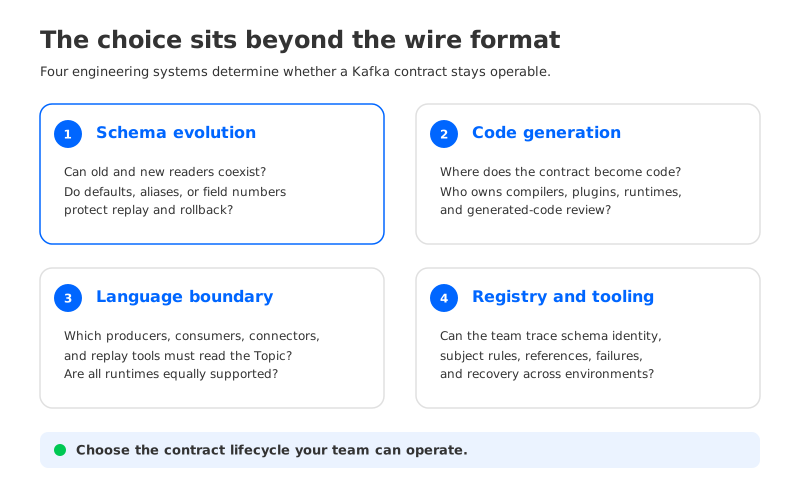
The practical question is therefore not “Which wire format wins?” It is “Which contract can this organization change, test, operate, and explain without surprising its readers?” Once that question is explicit, the Avro-versus-Protobuf debate becomes much easier to settle.
1Wire format is a constraint, not a strategy
Kafka stores and transports record keys and values. The broker does not infer whether a value is Avro, Protocol Buffers, JSON, or an application-specific byte sequence. The producer chooses a serializer, the consumer chooses a deserializer, and the surrounding platform carries the result. Apache Kafka documents those serializer and deserializer boundaries in its producer configuration reference.
The encoding still matters. It affects how a record is represented, how a consumer reconstructs it, and which compatibility rules can be applied before a producer publishes. But a payload-size comparison captures only one slice of the operating problem. The format also determines what a code review can see, how a field survives a rename, how a generated client changes, and what happens when old records are replayed after a deployment.
“Avro is smaller” is an incomplete answer even when it is true for a particular schema and workload. The result can change with field names, types, defaults, references, batching, and compression. A smaller payload can still create more engineering work than it removes.
2Four variables that actually decide the fit
Four questions usually explain why a team prefers one format even when the byte-level comparison points in the other direction.
2.1How will the schema evolve?
Avro is built around a writer schema and a reader schema. A reader can resolve records written under an earlier schema when the change follows the format's rules, such as adding a field with a valid default or retaining an alias during a rename. The Avro specification makes that resolution behavior explicit. This model fits teams that treat retained Kafka data and replay as first-class parts of the contract.
Protobuf uses field numbers as part of the wire contract. Removing a field does not make its number safe to reuse, and a field that disappears from the source definition may still exist in old records. Teams need to reserve field numbers and names when the history requires it, and they need to understand how unknown fields behave in the runtimes they ship. The Protocol Buffers language guide describes the rules that keep old and new message definitions from colliding.
Both formats can support compatible evolution. The difference is where the discipline is made visible. Ask which set of rules your reviewers can apply consistently.
2.2What does code generation mean for the team?
Protobuf commonly starts from an IDL and generates client types and accessors as part of the build. That gives a polyglot organization a shared source for the message shape, while also making compiler versions, plugins, generated-code diffs, and runtime libraries part of the release surface. The benefit is visible ownership: an incompatible change can fail in CI before it reaches a topic.
Avro can also generate classes, but many Kafka data platforms use schema-aware serializers and generic or specific readers in different combinations. That flexibility helps when a data platform serves many consumers with varied languages and query paths. It can also hide a contract change if teams validate only whether a schema parses rather than whether real reader and writer pairs still work.
Code generation is a coordination choice. Generated APIs require versioned compiler tooling, reviewed generated changes, and aligned runtimes. Schema resolution requires representative fixtures, compatibility checks, and clear reader behavior. Teams that need a repeatable gate can adapt the schema compatibility gate guide.
2.3Which languages and boundaries must cooperate?
A single-language platform can hide many choices inside shared libraries. A polyglot platform has to decide which languages are first-class, whether generated clients are maintained for each one, how optional values map to native types, and whether defaults or unknown values survive translation.
Protobuf often appeals to teams that want a common IDL and generated message types across service languages. Avro often appeals to data platforms where schema history, generic readers, and registry governance matter more than a shared generated API. Both cross language boundaries, and both create friction when a less-used language lacks a supported runtime path.
List every producer, consumer, connector, stream processor, replay job, and ad hoc reader that touches the Topic. A format that works for the main path but leaves an incident tool without a supported runtime is incomplete.
2.4What does the registry and tooling ecosystem own?
A Schema Registry is an operating system around schemas, not a property of Avro alone. It stores versions, applies compatibility rules, and helps serializers and deserializers resolve schema identity. Protobuf can also be used in registry-backed Kafka workflows, but the envelope, subject naming, references, runtime, and compatibility behavior must be tested together.
A team may already have subject naming rules, CI checks, promotion paths, access controls, and recovery procedures built around Avro. Another may have a .proto repository, code-generation pipeline, and language plugins that make Protobuf the lower-friction option. Switching formats without changing those controls rarely improves the system.
Ask what happens when a producer cannot reach the registry, a consumer replays retained records, or an operator needs to identify the writer schema and serializer version. If those answers are unclear, the format choice is not ready for production.
3A four-dimension comparison
The table below is a starting point for a design review. “Tends to fit” is deliberately conditional. It describes the work each format makes easier, not a universal ranking.
| Dimension | Avro tends to fit when | Protobuf tends to fit when | Check before choosing |
|---|---|---|---|
| Schema evolution | Readers and writers must resolve multiple retained versions, with registry compatibility and explicit defaults or aliases. | Teams can enforce field-number discipline, reserve removed fields, and test earlier and proposed generated messages together. | Which rollout order, replay window, and rollback path must remain valid? |
| Code generation | Generic or specific readers need to coexist, and schema files are the primary contract artifact. | Generated types and accessors should be the default API for application teams. | Who owns compiler, plugin, runtime, and generated-code upgrades? |
| Cross-language collaboration | Data platform consumers use different access patterns and can share registry-backed schemas. | Service teams need one IDL and generated clients across supported languages. | Which language, connector, or replay tool is least supported? |
| Registry and tooling | The organization already has mature Avro subjects, compatibility checks, and replay procedures. | The organization already has a .proto repository, CI generation, and registry integration that it can operate. | Can you trace schema identity, references, failures, and recovery in every environment? |
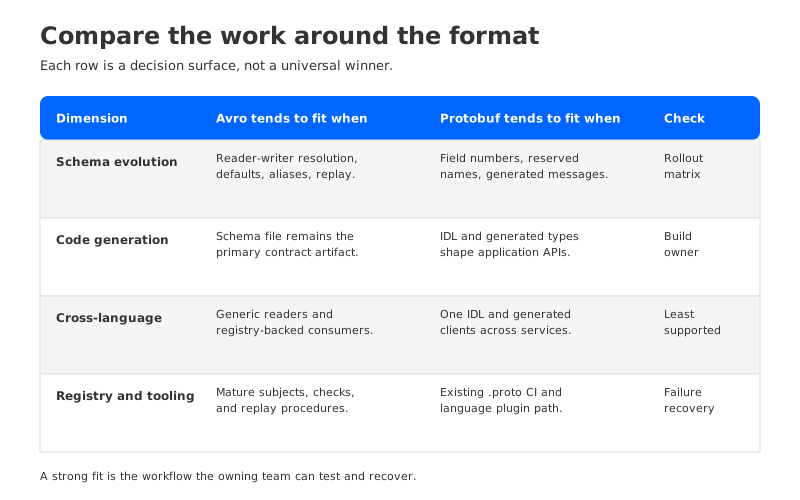
The table also shows why “which one is more efficient?” is usually the wrong opening question. Efficiency belongs inside the decision, but the relevant unit is the work needed to keep contracts correct. A smaller payload does not compensate for a schema process that nobody can safely change, and generated code does not remove the need for registry and replay tests.
4Match the format to the team you actually have
The same Kafka cluster can contain teams that make different choices for sound reasons. A useful decision guide starts with operating habits rather than brand preference.
The registry-first data platform team. This team owns long-lived Topics, replay, connectors, and analytical consumers. It already reviews compatibility, manages subject naming, and treats retained data as part of the contract. Avro often fits because reader-writer resolution and registry policy are already daily work, provided the team tests its actual consumer languages and keeps defaults, aliases, and references under review.
The polyglot service organization. This team has services in several languages and already uses IDLs to coordinate APIs. It wants generated types, predictable field access, and a build step that fails when the contract changes. Protobuf often fits this shape, but a service IDL does not cover subject naming, serializer configuration, replay, or consumer-group rollout.
The mixed estate with a long history. This team has generic data consumers, generated clients, and Topics whose records outlive their creators. It should choose per contract boundary, or keep the established format, rather than migrate for stylistic consistency. Inventory old writers, active readers, retained records, connectors, and the compatibility direction that protects the rollout.
The small platform team with no registry habit yet. Its first decision is governance, not encoding. Agree on schema ownership, change review, artifact versioning, and failure handling before choosing a format. A clear process will matter more than a small difference in encoded size.
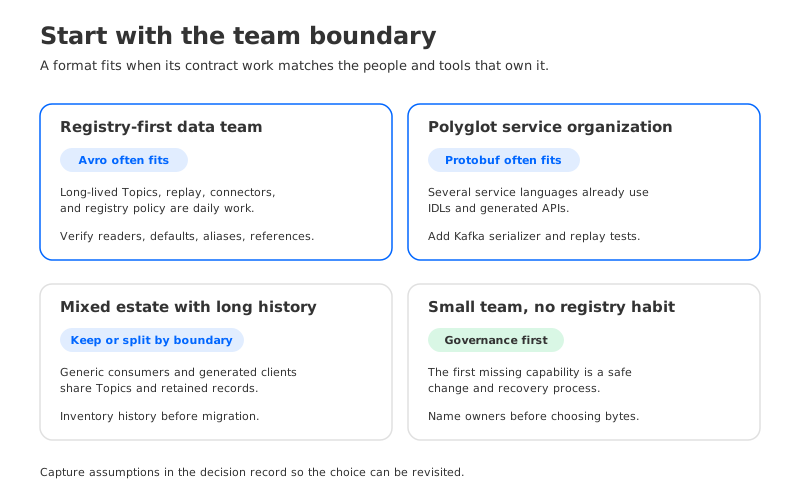
A team can move from one profile to another as its boundaries change. That is why a decision record should capture assumptions, not only the selected format. If the organization adds another language, an additional connector, or a longer replay window, the old decision may need a new check.
5Why performance rarely settles the choice
Serialization performance matters when it is on the critical path. It can affect producer CPU, consumer CPU, allocation behavior, record size, compression, network traffic, and the amount of data a consumer must parse. Those effects interact with message shape and batch behavior, so a benchmark that isolates serialization time cannot answer the whole Kafka question.
A useful performance test uses the workload that drives the decision. Measure representative records, field distributions, batch sizes, compression settings, producer and consumer CPU, end-to-end latency, and replay behavior. Include the registry path where the client depends on it, and record what happens when the registry is slow or unavailable. If the workload is not sensitive to payload size or serialization CPU, the benchmark should not overrule a large difference in schema governance effort.
There is another trap: teams sometimes treat the wire format as the performance boundary when the dominant cost sits in the application. A consumer may spend more time validating business rules, mapping generated types, writing to a sink, or waiting on downstream storage than decoding the record. The right question is not whether Avro or Protobuf is faster in isolation. It is whether the format changes the bottleneck in the workload you operate.
This is also why an existing estate deserves respect. If the current format meets latency and throughput targets, supports the required languages, and has a working evolution process, a migration needs a concrete reason. Another format introduces dual-read or dual-write windows, contract fixtures, registry or code-generation changes, and another failure mode during rollback. The schema evolution review guide shows why those boundaries deserve an explicit test. “The other format looked smaller” is not enough.
6Where a Kafka-compatible platform fits
By this point, the platform requirement is clear: preserve the Kafka record path, keep the serializer and deserializer choices visible, and let the data contract team own the evolution rules. The streaming platform should not make the application choose a proprietary serialization format to use the topic.
AutoMQ is a Kafka-compatible streaming platform, so its role in this decision is intentionally neutral. The choice between Avro and Protobuf stays with the producer, consumer, registry, and code-generation workflow. AutoMQ's Kafka compatibility documentation and architecture overview are useful for validating the platform boundary, while your own test should exercise the exact serializers, registry, clients, and replay paths you plan to run.
That boundary is valuable because storage architecture and data contracts solve different problems. A platform can change how brokers store and serve Kafka data without changing what a CustomerCreated record means or which field number a Protobuf message reserves. Keep those decisions separate. It makes a platform evaluation clearer and keeps the serialization choice portable across Kafka-compatible environments.
If the team is comparing a format and a platform at the same time, use two test tracks. First, prove the contract lifecycle with the chosen serializer and registry. Then, prove that the platform preserves the Kafka client behavior, record delivery, consumer-group operations, and replay expectations that the contract depends on. A format decision should not be used as a proxy for a storage decision.
7The one-hour decision checklist
Set aside one hour with the producer owner, a downstream consumer owner, and the platform or data governance owner.
- What does this record mean, and who owns that meaning? Write down field semantics, units, null and unknown behavior, key identity, and the team accountable for changes.
- Which writers and readers must coexist? Include the rollout order, retained history, replay jobs, connectors, and rollback reader. Choose the compatibility direction from that matrix.
- Where should the contract live? Decide whether the source of truth is a schema file in a registry workflow, a
.protodefinition with generated artifacts, or a controlled combination. Name the repository and review owner. - Which languages and runtimes are real dependencies? List current and planned producers, consumers, stream processors, connectors, and operational tools. Verify generated-code or runtime support for each one.
- What does the registry own? Record subject naming, schema identity, references, compatibility mode, access policy, failure behavior, and the recovery path when the registry is unavailable.
- What would make performance the deciding factor? Define the workload evidence that could overturn the governance decision: record shapes, compression, batch behavior, CPU, latency, and replay. If no measurement can change the decision, do not make payload size the headline.
- What is the exit or rollback path? Keep the old reader, schema, generated artifact, and test fixture available for the period in which earlier records and proposed records can meet.
The output can be a short page with the chosen format, assumptions, compatibility mode, owners, test fixtures, and review date. If the team cannot answer the questions, close the governance gaps before changing every producer.
The team that says “Avro is smaller, but this feels awkward” is usually pointing at a real design problem. The awkwardness may come from code generation, language boundaries, registry ownership, or an evolution rule that no one can explain. Once those variables are visible, Protobuf or Avro becomes a manageable engineering decision, and the wire format returns to its proper place: one constraint inside a contract lifecycle.
If you want to test that lifecycle on a Kafka-compatible streaming platform, start with the AutoMQ Open Source repository, then run the same serializer, registry, replay, and client checks against the environment you operate.


