
Table of Contents
Table of Contents
Amazon MSK is often the most straightforward Kafka choice on AWS. It keeps the Apache Kafka API close to the upstream project, fits AWS procurement, integrates with IAM and CloudWatch, and avoids the operational burden of building every broker, disk, upgrade, and security workflow from scratch.
The problem starts when the workload stops behaving like a steady cluster. If traffic bursts, retention grows, or teams need to scale brokers quickly without long partition movement, the classic Kafka model still matters: brokers carry both compute and persistent data, and changing the broker fleet can become a storage and rebalance event. MSK improves the managed-service surface, but it does not erase every architectural tradeoff behind Kafka on block storage.
So the real question is not "What is the best MSK replacement?" It is more specific: which AWS Kafka or event-streaming option gives your team the right boundary between protocol compatibility, elasticity, cost control, and operational ownership?
1Quick Answer
For AWS teams that want Kafka compatibility and more elastic storage economics, AutoMQ, Confluent Cloud, WarpStream, Redpanda Cloud, Aiven for Apache Kafka, self-managed Kafka, and Apache Pulsar are the most relevant alternatives to evaluate. They are not interchangeable. Some preserve Kafka protocol compatibility, some optimize for fully managed operations, some push you toward BYOC, and one is a different streaming system with a Kafka-compatible gateway rather than a drop-in Kafka cluster.
| Option | Best fit | Kafka compatibility posture | AWS deployment model | Main tradeoff |
|---|---|---|---|---|
| AutoMQ | Elastic Kafka-compatible workloads using S3-backed storage | Kafka-compatible streaming platform | BYOC with control plane and data plane in the customer AWS account/VPC | Newer architecture to evaluate against your SLOs |
| Confluent Cloud | Fully managed enterprise streaming and broad ecosystem features | Managed Kafka-compatible service | Confluent-managed or BYOC options depending on plan and region | Premium managed-service model and feature complexity |
| WarpStream | BYOC Kafka protocol workloads optimized around object storage | Kafka protocol compatible | Runs agents in your cloud account and stores data in object storage | Higher architectural shift from broker-disk Kafka |
| Redpanda Cloud | Kafka API workloads that prefer a simpler broker model | Kafka API compatible | Managed service and BYOC options | Different engine under the Kafka API |
| Aiven for Apache Kafka | Managed open-source Kafka with predictable operations | Apache Kafka service | Aiven-managed service on AWS regions | Less architectural change than object-storage-native systems |
| Self-managed Kafka on EC2/EKS | Teams that need full control or custom builds | Apache Kafka | Your AWS account | Highest operations burden |
| Apache Pulsar | Multi-tenant pub/sub with tiered storage and flexible subscriptions | Different system; Kafka-on-Pulsar possible | Self-managed or vendor-managed on AWS | Migration is an application and operations project |
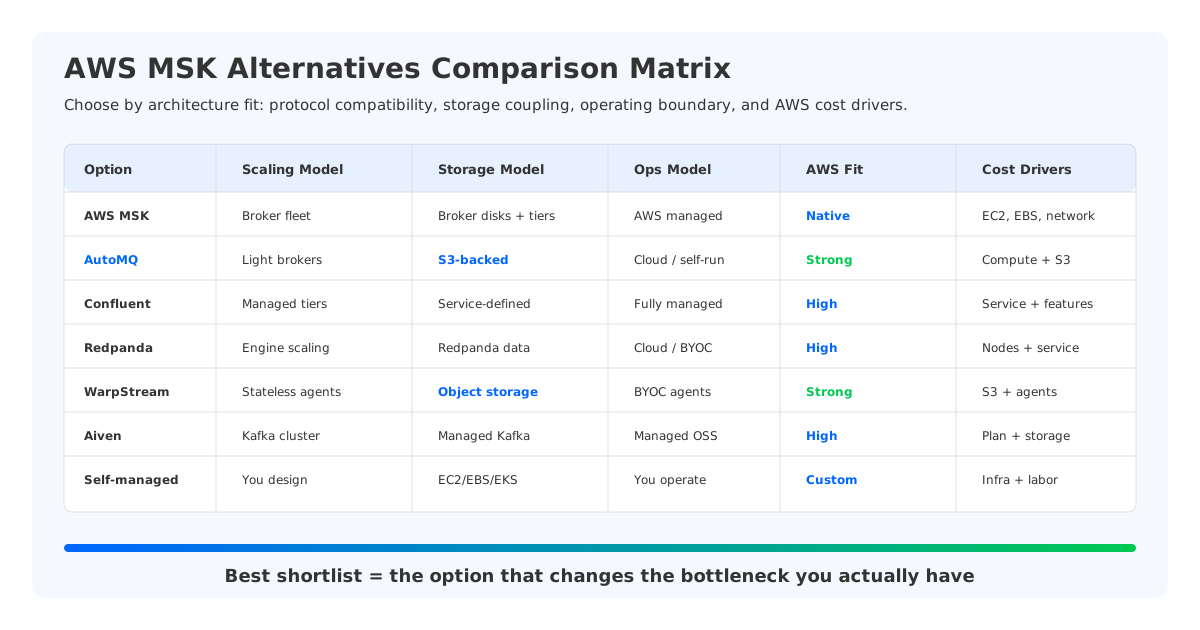
This table is intentionally scenario-driven. If procurement wants a familiar managed service, Confluent Cloud or Aiven may be the natural shortlist. If the storage model is the pain, AutoMQ or WarpStream deserve a closer look. If the team wants to leave Kafka architecture behind, Pulsar belongs in the conversation, but it should not be treated as a transparent MSK swap.
2When AWS MSK Is Still A Good Fit
MSK is a good fit when the workload is relatively predictable, the team wants managed Apache Kafka rather than a different streaming engine, and AWS-native integration carries more value than deep architectural change. Amazon documents separate options for provisioned MSK and MSK Serverless, and MSK pricing separates broker instance usage, storage, data transfer, and optional features such as tiered storage or private connectivity on the official MSK pricing page. That model is familiar to teams already operating EC2, EBS, and VPC networking.
MSK also has a conservative advantage: it keeps many Kafka decisions recognizable. You still think in brokers, partitions, client quotas, storage, replication, and Kafka upgrades. For platform teams with existing Kafka skills, this can be a feature rather than a limitation. A service that changes fewer assumptions is easier to explain during incident response.
The fit weakens when the workload asks the platform to behave like elastic cloud infrastructure rather than a fixed broker fleet. Kafka can scale, but scaling a broker-backed cluster is not the same as scaling a stateless application tier. Partition placement, broker storage, replication traffic, and client behavior all have to settle into the new shape.
3Why Teams Look For AWS MSK Alternatives
Most MSK alternative searches start from one of four pressures: scaling speed, storage cost, cross-AZ traffic, or operational control. These pressures overlap. A long-retention workload may drive EBS usage first, then broker count, then replication and network charges. A bursty workload may start as a capacity-planning problem and become a rebalancing problem.
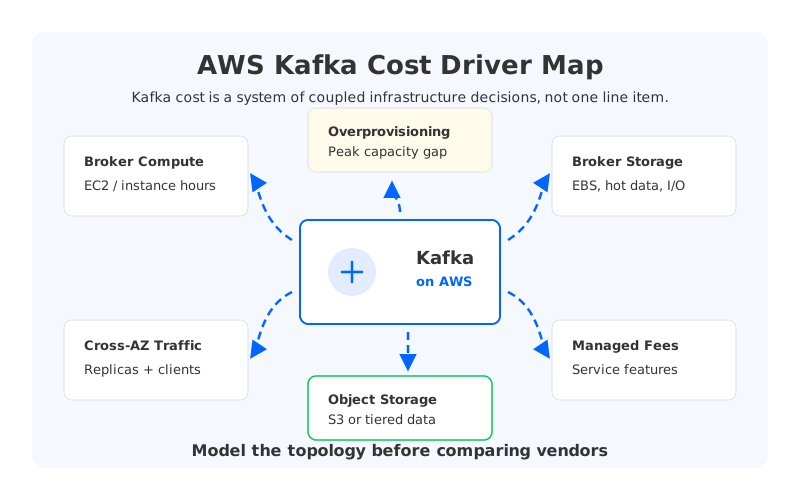
The cost model is especially easy to underestimate because Kafka has several cost drivers that do not show up as one line item:
- Broker compute is sized for peak traffic, partition count, and operational headroom. When utilization is spiky, the gap between average load and provisioned capacity becomes part of the bill.
- Broker-attached storage has to hold retained data and absorb write/read behavior. MSK supports tiered storage for supported Kafka versions, but storage architecture still determines how much hot broker storage and operational movement you carry.
- Cross-AZ traffic can become material when replication, producers, and consumers move data across availability zones. AWS publishes separate EC2 data transfer pricing and service pricing pages, so teams should model their actual topology rather than assume all in-region movement is free.
- Managed-service fees buy operational offload, security integration, upgrades, and support. That can be worth it, but it should be visible in the comparison rather than hidden behind a single "managed Kafka" label.
Elasticity is the other major driver. MSK Serverless removes some provisioning work, and AWS documents its serverless pricing separately from provisioned clusters on the MSK pricing page. But serverless Kafka is not automatically the right answer for every workload: teams still need to check service limits, throughput patterns, feature support, networking, security requirements, and migration complexity against their production needs.
4Top AWS MSK Alternatives Compared
4.1AutoMQ
AutoMQ is worth evaluating when the MSK pain is architectural rather than administrative. Its core idea is to keep Kafka compatibility while moving persistent stream data to object storage such as S3, making brokers lighter-weight and reducing the amount of durable state tied to individual broker instances. AutoMQ describes this storage-separated design in its official documentation, and the design is aimed at teams that want Kafka semantics with cloud-native elasticity.
AutoMQ's BYOC boundary is also stricter than many managed BYOC products. Its environment overview states that the control plane system, the environment console, and the data plane system, the Kafka service cluster, are both deployed in the user's network environment. On AWS, the installation guide requires the AutoMQ console EC2 instance to be in the same VPC as the AutoMQ cluster that will be deployed later. That makes AutoMQ relevant when the MSK alternative search is about both storage architecture and customer-VPC-resident control.
That matters on AWS because S3 is not just a low-cost storage target; it also changes what scaling means. In a traditional broker-disk model, adding or removing brokers can involve moving partition data and rebalancing disk ownership. In a storage-separated model, compute and storage can be scaled with less coupling, so broker changes do not have to carry the same volume of persistent data movement.
AutoMQ is not the default choice for every AWS team. If your organization wants a long-established managed ecosystem with a large marketplace of adjacent services, Confluent may be easier to justify. If your team wants Apache Kafka exactly as upstream packages it, Aiven or self-managed Kafka may feel more familiar. AutoMQ is strongest when the workload profile makes broker-attached storage the bottleneck: bursty traffic, long retention, fast scale-out/scale-in, and cost-sensitive AWS deployments.
4.2Confluent Cloud
Confluent Cloud is the natural benchmark for fully managed Kafka-compatible streaming. It offers a broad platform around Kafka, including managed connectors, governance capabilities, stream processing, security features, and cloud deployment options. Confluent documents cloud provider and networking choices in its Confluent Cloud documentation, and teams evaluating AWS deployment models should check the current plan, region, and networking support directly in those docs.
The advantage is operational breadth. If the migration away from MSK is really a migration toward a managed streaming platform, Confluent has depth beyond the broker layer. That can reduce the number of tools a data platform team has to assemble around Kafka.
The tradeoff is that Confluent Cloud is more than "MSK with a different logo." Pricing, governance, networking, connector usage, support boundaries, and cluster type all become part of the decision. For teams whose main pain is S3-backed elasticity on AWS infrastructure, it may be more platform than they need. For teams that want a mature managed data-streaming ecosystem, it is often one of the first alternatives to test.
4.3WarpStream
WarpStream takes a more radical cloud-native stance: it is Kafka protocol compatible, but it stores data directly in object storage and runs stateless agents in your cloud account. WarpStream's official docs describe this as a BYOC architecture where agents run in your VPC and use object storage such as S3 as the storage layer; start with the WarpStream documentation and current product pages when validating feature support.
This model is attractive when the team wants to avoid broker-local disks and reduce the operational consequences of moving data between brokers. Because the storage system is object storage rather than broker-attached volumes, the cost and scaling model can look very different from MSK provisioned clusters.
The tradeoff is architectural distance. Kafka clients may connect through a Kafka-compatible protocol surface, but the operational model is not the same as running Apache Kafka brokers. Teams should test latency, client behavior, consumer group behavior, connector compatibility, and failure modes under their own workloads before treating it as a drop-in replacement.
4.4Redpanda Cloud
Redpanda Cloud is a managed streaming option built around Redpanda's Kafka API compatibility rather than Apache Kafka itself. Redpanda documents its Kafka API support and cloud deployment choices in the Redpanda documentation. For teams that like the Kafka API but want a different broker implementation, Redpanda belongs on the shortlist.
The appeal is simplicity at the engine level. Redpanda has historically positioned itself around a simpler architecture than JVM-based Kafka deployments, and Redpanda Cloud can reduce the operations surface compared with self-managed clusters. On AWS, teams can evaluate it as a managed alternative where Kafka client compatibility is important but upstream Kafka internals are not sacred.
The tradeoff is ecosystem semantics. Kafka compatibility is not the same as being Apache Kafka in every operational detail. Before moving from MSK, test your exact clients, admin tooling, connectors, security configuration, consumer group behavior, and observability stack.
4.5Aiven For Apache Kafka
Aiven for Apache Kafka is a good fit when the team wants managed Apache Kafka without adopting a fundamentally different storage architecture. Aiven documents its Kafka service, cloud choices, backups, upgrades, and operational features in the Aiven for Apache Kafka docs. For AWS teams, this is often a pragmatic alternative when procurement, support model, or cross-cloud consistency matters.
The value is straightforward: Apache Kafka as a managed service, operated by a specialist provider, with less platform sprawl than a broader streaming suite. If the existing MSK workload is healthy but the team wants a different support boundary or multi-cloud operating model, Aiven is easy to understand.
The limitation is also straightforward. If the pain comes from the broker-disk architecture itself, moving to another managed Apache Kafka service may not change the underlying scaling and storage mechanics enough. It can be a better operator boundary without being a fundamentally more elastic architecture.
4.6Self-Managed Kafka On EC2 Or EKS
Self-managed Kafka is the unglamorous alternative that still matters. It gives the team control over Kafka version, broker configuration, storage layout, instance families, networking, security tooling, and upgrade timing. On AWS, that usually means EC2 with EBS, EKS with a Kafka operator, or a carefully controlled hybrid of the two.
This option makes sense when the team already has strong Kafka operations capability or needs custom behavior that managed services do not expose. It can also be useful as a transition path: prove the workload characteristics, then move to a managed or storage-separated platform once the bottleneck is understood.
The cost is operational load. You own broker failures, upgrades, partition reassignment, capacity planning, security patches, backup/restore strategy, observability, incident response, and on-call knowledge. For many teams searching for MSK alternatives, that is exactly the work they were trying to reduce.
4.7Apache Pulsar
Apache Pulsar is not a Kafka clone, but it appears in MSK alternative discussions because it separates serving and storage more explicitly than classic Kafka and supports multi-tenancy, tiered storage, and flexible subscription models. The Apache Pulsar project documents Kafka integration through its Kafka connector documentation and older Kafka client adapter documentation, but teams should validate the current support matrix against their clients and production semantics.
Pulsar can be compelling when the real goal is to rethink the event-streaming layer rather than replace MSK one-for-one. If you need multi-tenancy, geo-replication patterns, or a different subscription model, Pulsar may be the right platform conversation.
It is also the least drop-in choice in this list. Moving from MSK to Pulsar can affect client libraries, operations, observability, data governance, and team skills. Treat it as a platform migration, not a Kafka service swap.
5How To Choose By Scenario
Start with the constraint that hurts most in production. If the pain is unclear, every vendor can sound plausible and the comparison turns into a feature checklist. A better shortlist starts from the bottleneck.
| Scenario | Shortlist first | Why |
|---|---|---|
| You need Kafka compatibility but faster elastic scaling on AWS | AutoMQ, WarpStream, Redpanda Cloud | These options change the broker/storage or engine model more than a traditional managed Kafka service. |
| You want the broadest managed streaming platform | Confluent Cloud | The ecosystem around Kafka is often the reason to choose it. |
| You want managed Apache Kafka with a different operator | Aiven, Confluent Cloud, MSK provisioned comparison | These preserve a familiar Kafka operating model. |
| You need full AWS-account control | AutoMQ, WarpStream BYOC-style deployments, self-managed Kafka | Control plane, data plane, and networking boundaries become central. |
| You want to leave Kafka architecture behind | Pulsar, Redpanda, WarpStream | These require deeper compatibility and operations testing. |
| You mostly want lower storage cost for long retention | AutoMQ, WarpStream, MSK tiered storage evaluation | Object storage and tiered storage change the storage economics in different ways. |
The most useful proof of concept is not a hello-world producer and consumer. Run the ugly parts: broker scale-out, consumer lag recovery, retention growth, AZ failure assumptions, connector behavior, ACL/IAM mapping, observability, and a rollback path.
6Migration Considerations From MSK
MSK migration planning should start before the alternative is chosen. AWS provides Amazon MSK Replicator for replicating data between MSK clusters and Kafka clusters in supported configurations, while Kafka ecosystem tools such as MirrorMaker 2 and vendor-specific replication tools may also be relevant depending on the target platform. The right path depends on how much downtime the application can tolerate and whether producers, consumers, and schemas can be changed in stages.
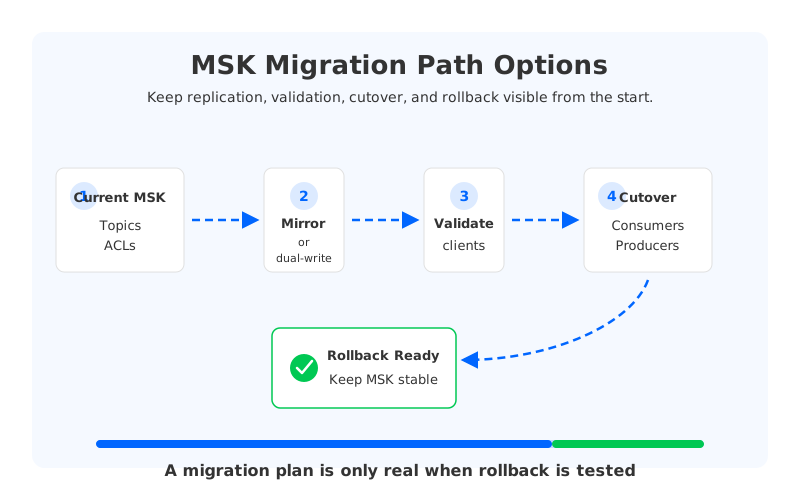
A practical migration plan usually has five checkpoints:
- Inventory topics, partitions, retention, ACLs, schemas, connectors, and consumer groups. The target platform may support the Kafka API, but that does not guarantee every operational assumption moves unchanged.
- Establish replication or dual-write for critical topics. Keep the rollback path explicit rather than relying on hope during cutover.
- Validate client behavior under real traffic patterns. Pay attention to rebalances, offset handling, idempotent producers, transactions if used, and lag recovery.
- Cut over consumers before or alongside producers depending on ordering and replay requirements. A clean migration plan makes offset ownership and replay windows visible.
- Keep MSK available until the new system has survived production load, not just a staging test.
This is where architecture differences become concrete. A storage-separated Kafka-compatible system may reduce future scaling pain, but the first migration still has to respect Kafka's state: topics, offsets, ACLs, schemas, and client assumptions. There is no vendor shortcut around that inventory.
7Where AutoMQ Fits
AutoMQ fits best when an AWS team likes Kafka's protocol and ecosystem but dislikes tying persistent stream data to broker disks. The architectural bet is simple: use S3 as the durable storage foundation, keep brokers lighter, and make scaling closer to a compute-plane operation than a data-movement project. The deployment boundary is equally important: AutoMQ BYOC keeps the environment console/control plane and Kafka service/data plane inside the user's AWS account and VPC, with maintenance based on customer authorization and read-only observability access. That is especially relevant for elastic workloads where peak traffic, retention, partition movement, and governance requirements make provisioned broker fleets feel stiff.
The balanced way to evaluate AutoMQ is to compare it against the real MSK pain rather than against a generic feature list. If MSK is working and the main requirement is a fully managed AWS-native procurement path, staying on MSK may be rational. If the pain is storage growth, overprovisioned brokers, or slow elasticity, AutoMQ should be tested with the same traffic pattern, retention settings, and failure assumptions that made MSK uncomfortable.
For architecture details, start with the AutoMQ documentation. For a guided discussion, use the AutoMQ contact page.
8FAQ
8.1What is the best AWS MSK alternative?
There is no universal best alternative. AutoMQ and WarpStream are strong candidates when storage-separated elasticity is the main concern. Confluent Cloud is strong when the team wants a broad managed streaming platform. Aiven is useful when the goal is managed Apache Kafka with a different operator. Redpanda and Pulsar are stronger when the team is open to a different engine or platform model.
8.2Is MSK Serverless an alternative to MSK provisioned clusters?
MSK Serverless can be an alternative for some workloads because it changes the provisioning model. It should still be evaluated against current AWS limits, pricing, feature support, networking requirements, and workload patterns using the official MSK documentation and pricing page.
8.3Which alternatives are Kafka-compatible?
AutoMQ, Confluent Cloud, WarpStream, Redpanda, Aiven for Apache Kafka, and self-managed Kafka all target Kafka-compatible client experiences in different ways. Pulsar is a different system, although Kafka-on-Pulsar can provide Kafka protocol support for some use cases. Compatibility should always be tested with your clients, admin operations, security settings, and connectors.
8.4Can I migrate from MSK without downtime?
Some migrations can be designed for minimal downtime using replication, dual-write, staged consumer cutover, and rollback planning. Whether it is truly zero downtime depends on ordering requirements, client behavior, schema compatibility, offset handling, and the target platform. Test the failure and rollback path, not just the happy path.
8.5Are AWS MSK alternatives lower cost?
They can be, but only under specific workload assumptions. Storage-separated systems can improve economics for long retention or elastic traffic, while managed platforms may cost more but reduce operational work. Model broker compute, storage, cross-AZ traffic, managed-service fees, connector usage, support, and staff time before calling any option lower cost.


