
Table of Contents
Table of Contents
The day you leave a Kafka platform, the first question is rarely “how do we copy the brokers?” It is “which parts of this system are still ours?” Topic records, Kafka client code, Kafka Connect plugins, schema definitions, and many operations scripts can travel with you when they use standard Kafka interfaces and open serialization formats.
That portability has a condition. A Kafka-compatible endpoint is useful when its protocol, record format, and surrounding contracts remain understandable outside the hosting platform. Provider control planes, identity systems, storage layouts, and proprietary data paths need separate planning.
1Take inventory before you need to leave
Portability is an attribute of an asset, not a property that a platform earns in one broad yes-or-no statement. A topic can be portable while its consumer group state needs reconstruction, and a connector plugin can be portable while its managed deployment and secret bindings cannot. A client application can keep its Kafka API calls and still need changes to bootstrap addresses, authentication, quotas, or vendor-specific configuration.
Start with an inventory that records each asset, its interface and format, and evidence that another Kafka environment can consume it. Record what is excluded as well. For “topic data,” add the export method, retention boundary, serializers, headers, timestamps, and treatment of offsets. For “connector,” name the plugin binary, configuration, source or sink, credentials, and runtime.
The following distinction keeps the review honest:
- Portable asset: can be exported or rebuilt from an open interface and used by another Apache Kafka environment with bounded configuration work.
- Portable with translation: the useful content can move, but identifiers, offsets, credentials, or deployment metadata need a deliberate mapping.
- Platform-specific asset: depends on a proprietary API, storage layout, control plane, identity boundary, or runtime extension.
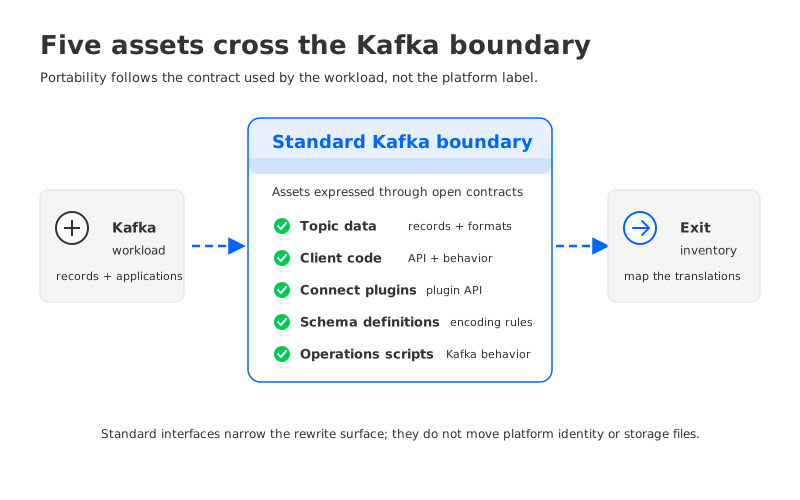
The middle category keeps translation from being mistaken for either a rewrite or zero work, so the assets can be checked one by one.
2Standard assets: data, clients, connectors, schemas, and scripts
2.1Topic data is portable at the record layer
Kafka topic data is an ordered set of records organized by Topic and Partition. Records carry keys, values, timestamps, headers, and offsets. The record payload is portable when the source and target understand the same Kafka protocol and the same Serialization / Deserialization format. In practice, teams move it through a Kafka-aware replication path, an export and import process, or an application-level replay path. The method changes the operational work, but the thing being preserved is the record contract.
Raw broker log directories deserve a separate line in the inventory. They contain segment files, indexes, checkpoints, and metadata tied to a cluster layout, so copying them is not the same as exporting topic data through Kafka semantics. Treat the portable object as the record stream and its contract, then document how keys, headers, timestamps, retention, compaction, and ordering are preserved.
Consumer group offsets are attached to cluster group metadata and should be treated as portable with translation. A target cluster can start consumers from an agreed offset, timestamp, checkpoint, or application-defined handoff point, but the numeric offset is meaningful within the corresponding Partition history. Include the cutover position and verify that consumers reach it. Topic bytes can move while a downstream application reprocesses or skips data if this boundary is implicit.
2.2Client code usually survives the endpoint change
Producer and Consumer applications built against standard Kafka client APIs normally retain their message handling, batching, retry, acknowledgment, and consumer group logic. The code may need a different bootstrap server and credentials, but those are deployment inputs rather than a different application protocol. Kafka Streams applications and other ecosystem tools still require a compatibility test because they exercise more than a single produce or fetch request.
The nonportable part is often hiding in configuration. Private endpoint names, cloud IAM providers, TLS trust bundles, SASL mechanisms, quota assumptions, rack or zone hints, and vendor-specific client properties can matter as much as the Java, Go, Python, or .NET code. Keep the effective configuration and label each property as standard, environment-specific, or platform-specific.
2.3Kafka Connect plugins travel when their contracts do
Kafka Connect separates the connector plugin from the runtime that schedules tasks and manages workers. A connector plugin that uses the Kafka Connect API, ordinary client configuration, and a standard source or sink contract is a reusable software asset. Preserve the plugin artifact, version, dependency list, connector configuration, transforms, converters, and the external system assumptions that the plugin needs.
The runtime state around that plugin needs a separate accounting. Worker configuration, internal topics, task offsets, status records, secrets, network routes, and managed catalog metadata can belong to the source platform or the specific Connect deployment. A sink connector may be portable as a binary while its destination permissions, endpoint, table mapping, and exactly-once behavior still need testing.
A clean inventory splits a connector into four rows: plugin, configuration, runtime state, and external dependency. That split answers whether the team is moving software or a running integration with its identity, checkpoints, and destination commitments. The first is often portable. The second is a migration project.
2.4Schema definitions are portable; registry identity may not be
Schema portability depends on two layers. The first is the definition itself: Avro, JSON Schema, or Protobuf files, plus field types, defaults, compatibility rules, and the serializer or deserializer configuration used by clients. Those artifacts can be stored in source control and loaded into another schema service. The second layer is registry behavior: subjects, versions, compatibility modes, schema IDs, references, authentication, and the wire format that places an ID beside a record payload.
Moving the definition without checking the wire format can create a quiet failure. A consumer may fetch the schema text and still fail to decode records because the schema ID namespace or subject naming rule changed. Export definitions and registry metadata together, then test records from before and after cutover. The portable asset is the data contract plus a known encoding path, not a registry URL by itself.
2.5Operations scripts are portable when they describe Kafka behavior
The most durable operations assets are the ones that speak in Kafka concepts: create a Topic, alter retention, inspect consumer lag, describe Partition assignments, check replication health, and apply a documented client configuration. Scripts built around the Kafka command-line tools or AdminClient can often be adapted by changing endpoints, credentials, and the small set of capabilities that the target exposes.
The surrounding automation is where platform coupling accumulates. Cloud networking, IAM policies, load balancers, secrets managers, private link configuration, managed upgrades, billing exports, alert names, and provider-specific APIs do not move with a Kafka command. A runbook that depends on a provider console, proprietary metrics, or a managed service incident process needs a replacement.
Keep intent and implementation separate in the repository. “Ensure the payment-events topic retains the agreed history and has the required replication settings” is a portable requirement. “Call provider API X with policy Y” is one implementation. The separation makes the runbook reusable and exposes platform-specific work instead of letting it masquerade as Kafka configuration.
3Platform-specific assets and how to spot them
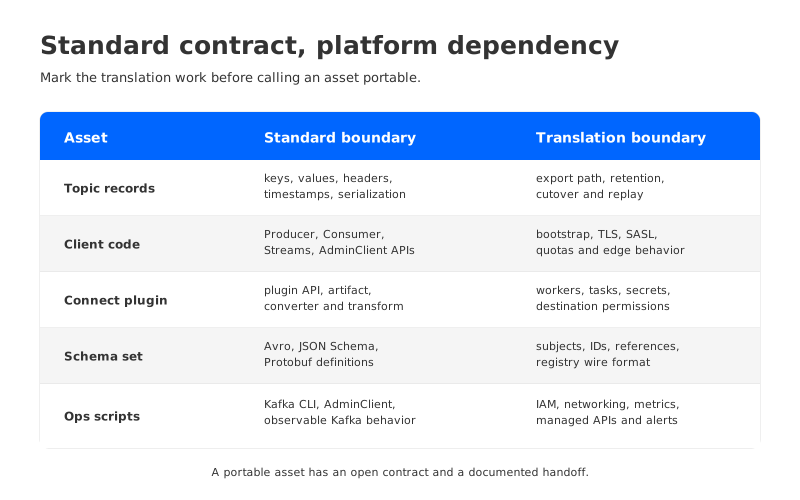
The fastest test for portability is to ask what the asset assumes about ownership. Does it need a provider account, a private control-plane API, a broker’s local filesystem, a proprietary serializer, a managed identity, or a service-specific routing rule? If removing the platform name makes the asset impossible to execute or decode, it belongs in the platform-specific column.
| Asset or dependency | Standard boundary | Common translation or platform-specific work |
|---|---|---|
| Topic records | Kafka records, keys, values, headers, timestamps, and serialization format | Export path, retention and compaction behavior, cutover point, replay policy |
| Client application | Kafka producer, consumer, Streams, and AdminClient APIs | Bootstrap servers, authentication, TLS, quotas, edge behavior, transactions |
| Connect plugin | Kafka Connect plugin API and artifact | Worker runtime, internal topics, secrets, task offsets, destination permissions |
| Schema set | Avro, JSON Schema, or Protobuf definitions and rules | Subject naming, schema IDs, references, registry wire format |
| Operations script | Kafka CLI, AdminClient, and observable Kafka behavior | Cloud IAM, networking, managed APIs, metrics, alert routing, billing |
| Broker storage files | Usually no portable contract at the file level | Cluster metadata, log layout, indexes, checkpoints, provider storage model |
This table guards against a common category error. A platform can expose a Kafka protocol endpoint while keeping the data path, schema service, connector runtime, and administrative surface proprietary. The exit plan should count those dependencies rather than treating the endpoint as proof that the operating model moves unchanged.
4The precondition: unmodified protocol and formats
The portable asset list works when the boundaries are real. Standard Kafka protocol requests and responses provide the client contract. Record fields, an agreed serialization format, Kafka Connect APIs, and open schema definitions provide the data and plugin contracts. Remove one of those anchors and the asset may still be recoverable, but its recovery cost rises quickly.
Serialization is the easiest boundary to miss because the payload can look opaque while the application appears healthy. Record values may be Avro, JSON Schema, Protobuf, JSON, or another encoding. Headers may carry routing or version information. A custom serializer can make the application efficient inside one environment while making the records unreadable elsewhere. Record a sample payload, serializer class, schema reference, compression setting, and decoding command for each critical topic.
The same rule applies to protocol extensions. A standard client property that tunes batching is different from a private request type. A Kafka Connect transform that uses a documented API is different from a proprietary worker hook. A topic configuration defined by Kafka is different from a control-plane policy that happens to change the topic. Label those differences while the system is calm.
This is where AutoMQ is a concrete compatibility example. AutoMQ is a Kafka-compatible cloud-native streaming platform that preserves the Kafka protocol and ecosystem surface while changing the storage architecture underneath. Its Shared Storage architecture uses S3Stream and S3-compatible object storage as the durable storage foundation, so broker storage is not an asset to assume can be copied. The portability question is whether client, record, schema, connector, and operations contracts stay within the workload’s standard boundary.
That distinction makes AutoMQ useful in an exit discussion without turning it into a product promise. A platform can change durable data placement and broker scaling while preserving the Kafka interface that applications already use. Teams still need to validate the APIs, serialization formats, connector behavior, authentication, and recovery path that matter to the workload. Compatibility reduces the rewrite surface; it does not remove the inventory.
5An asset census you can run this quarter
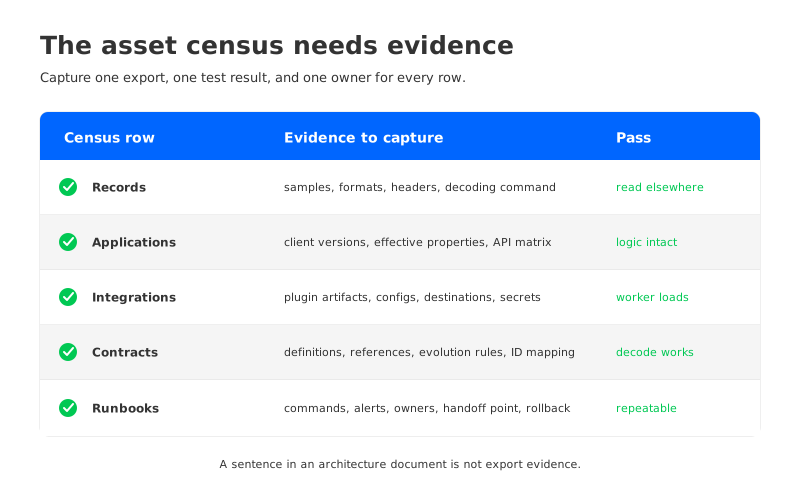
An exit plan becomes credible when another engineer can inspect the repository and reproduce the handoff without asking one person to remember how the platform was assembled. Run the census against one representative production workload first, then expand it to the rest of the estate.
| Census question | Evidence to capture | Pass condition |
|---|---|---|
| Can the records be decoded elsewhere? | Sample records, serializer and schema files, headers, compression, decoding command | A target environment reads historical and post-cutover records |
| Can the application connect with its logic intact? | Client versions, effective properties, TLS and SASL settings, API matrix | Produce, consume, admin, and required Streams behavior pass |
| Can each connector be rebuilt? | Plugin artifacts, versions, converters, transforms, configs, external dependencies | A clean worker loads the plugin and reaches a test destination |
| Can schemas evolve after cutover? | Definitions, references, subjects, compatibility rules, ID mapping | Existing and next-version records decode under the target rules |
| Can the operating intent be repeated? | Kafka commands, IaC, alerts, dashboards, runbooks, ownership | A second operator performs the core tasks without provider console knowledge |
| Can consumers resume at a known point? | Group membership, offsets or checkpoints, handoff timestamp, replay policy | The cutover position is verified and downstream reconciliation is complete |
The pass condition should be evidence. Store the export command, test result, target version, and owner beside the asset. If an item needs translation, write the mapping and rollback boundary. If it cannot be exported, record replacement work while the original system remains available.
The inventory gives procurement a sharper question than “Are we locked in?” Ask which assets are standard, portable with translation, or platform-specific. Then ask how often the team proves each row. A quarterly review can choose a topic, client, connector, schema family, and runbook; restore them in a disposable Kafka environment; and capture the gaps.
When the day to leave arrives, know which pieces are records and contracts you can carry, which require a mapping, and which are tied to the platform by design. Start with the five inventory rows, verify the protocol and serialization boundary, and the exit conversation becomes an engineering plan. To test that boundary with your Kafka workload, start an AutoMQ evaluation using the same pass conditions.
6References
- Apache Kafka protocol
- Apache Kafka Connect
- Apache Kafka serialization
- Apache Kafka operations
- Apache Kafka configuration
- AutoMQ architecture overview
- AutoMQ S3Stream shared streaming storage
7FAQ
7.1Is Apache Kafka portable between platforms?
The Kafka protocol, client APIs, record contracts, Connect plugin APIs, schema definitions, and Kafka-focused operations knowledge can be portable. Endpoint configuration, authentication, offsets, registry identity, connector runtime state, storage files, and cloud integrations may need translation.
7.2Can I copy Kafka broker data files to another platform?
Do not assume broker log directories are portable. They contain storage and metadata state tied to a cluster implementation. Plan around Kafka records, serialization formats, topic settings, and a verified export path.
7.3Are Kafka Connect connectors portable?
The plugin may be portable when it uses the Kafka Connect API and its dependencies are available. Worker configuration, internal topics, task offsets, secrets, destination permissions, and managed extensions need recreation and testing.
7.4Are Kafka schemas portable?
Schema definitions are portable when stored in an open format with compatibility rules, references, and serializer configuration. Registry subjects, schema IDs, and wire-format behavior require explicit mapping.
7.5Does Kafka compatibility mean zero migration work?
No. Compatibility can preserve application and integration contracts that use standard Kafka behavior, which narrows the rewrite surface. Credentials, cloud networking, consumer checkpoints, schema registry identity, connector runtime state, and platform-specific administration still need work.
7.6What should be in a Kafka exit inventory?
Record topic data and settings, client configuration, Connect plugins and runtime state, schemas and registry mappings, operations scripts, credentials, network dependencies, consumer handoff positions, and export or rebuild evidence.


