Diskless Apache Kafka® comparison

AutoMQ vs. WarpStream

Improve read/write efficiency and reduce cluster-wide failure risks.

AutoMQ colocates partition reads, writes, batching, and cache at the leader, with built-in balancing and partition moves in seconds. WarpStream adds routing to recover locality, while normal reads and writes depend on shared metadata services whose failure can stall the affected cluster.

  • Native locality through partition leadership
  • Automatic balancing and partition moves in seconds
  • No separate metadata service or backing database
  • Native Kafka ordering, idempotency, and transactions

AutoMQ’s leader-based architecture trade-offs

Architecture affects read/write efficiency, failure recovery, and the application changes a migration requires. AutoMQ retains partition leaders to colocate batching and cache, reduce external sequencing dependencies, and preserve Kafka semantics.

Data locality and read/write efficiency

Partition leaders provide better data locality by design

AutoMQ

Leader-based · Native partition locality
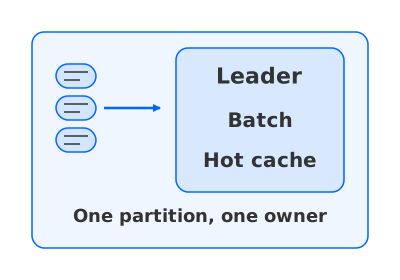
AutoMQ brings records for one partition to its leader for local batching and hot-cache reuse.
AutoMQ: colocated reads, writes, batching, and cache

Each partition has a designated leader. Reads and writes reuse local batching and hot cache, reducing the forwarding and coordination needed to gather requests and locate cached data.

AutoMQ: automatic balancing and partition moves in seconds

Built-in Self-Balancing adjusts partition placement automatically. Shared storage enables partition moves in seconds without copying historical data, preserving both leader locality and fast elasticity.

WarpStream

Leaderless · Additional mechanisms restore locality
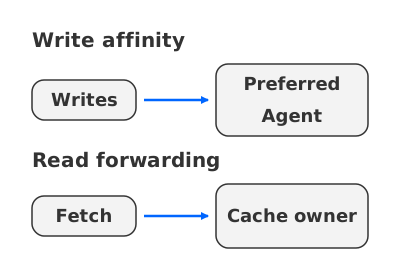
WarpStream uses write affinity to gather partition writes on one Agent and routes reads to the Agent holding the cached file.
Write affinity: bring partition writes back together

The recommended routing strategy sends most requests for a partition to the same Agent, reducing metadata, compaction, and live-fetch work.

Cache routing: forward reads to the cache owner

Read requests locate the Agent caching a file and are forwarded there to use the distributed cache.

These optimizations also bring distributed work back together, recovering the locality that partition leadership provides directly.
Availability and failure blast radius

Avoid an external metadata outage stalling the cluster

AutoMQ

Built-in KRaft + partition leaders

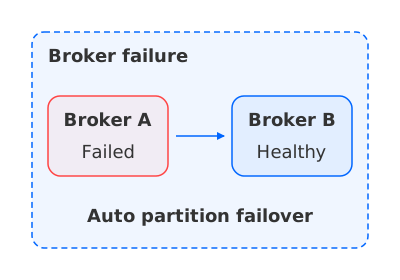
After one AutoMQ broker fails, healthy nodes automatically take over affected partitions without copying historical data.
AutoMQ: no separate vendor-hosted metadata service

Partition leaders order records while Kafka’s built-in KRaft manages metadata. No separate metadata service or backing database is required, removing an additional external dependency shared by all nodes.

AutoMQ: automatic takeover of affected partitions

When a broker fails, healthy nodes take over affected partitions and recover pending write-ahead log (WAL) data. Operators do not need to plan reassignments manually or copy historical data.

WarpStream

Shared metadata service + backing database or log

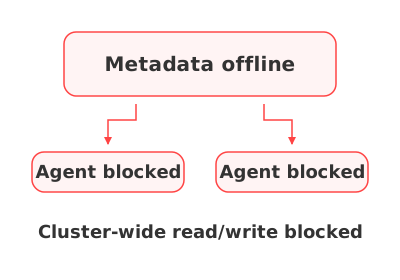
A WarpStream shared metadata outage affects multiple Agents, blocking normal production and consumption across the affected cluster.
A shared failure can block cluster-wide production and consumption

Every Classic Topics Agent depends on shared metadata commits and sequencing. Even if Agents and object storage remain healthy, failure of this dependency can stall the affected cluster. Adding Agents does not bypass it.

Reported incident: October 20, 2025 · AWS us-east-1

WarpStream reported that a downstream dependency failure prevented its control plane from processing Kafka requests, making production and consumption unavailable.

Ripcord: keep ingesting by relaxing semantics

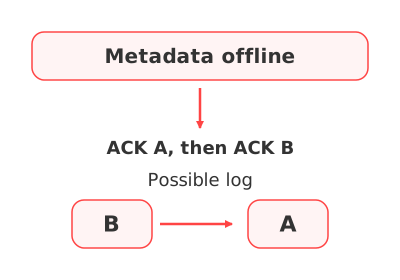
Running Agents acknowledge before sequencing, so a later-acknowledged batch may appear earlier in the log. Idempotent producers and transactions must be disabled. Consumers still wait for metadata recovery; full read/write availability is not restored.

Application compatibility and migration risk

Keep existing Kafka applications and reduce migration work

AutoMQ

Native Kafka broker logic and execution model

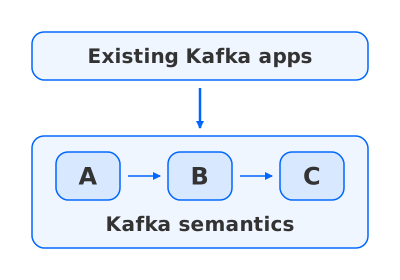
Existing Kafka applications connect to AutoMQ, where partition leaders preserve Kafka ordering and semantics.
AutoMQ: keep existing clients and ecosystem tools

AutoMQ retains Apache Kafka broker logic, so existing clients, Kafka Connect, and Kafka Streams can continue to be used, reducing application changes and compatibility validation.

AutoMQ: low latency with Kafka semantics intact

The WAL enables low-latency writes while retaining partition ordering, idempotent producers, and transactions. Earlier acknowledgments do not require disabling these guarantees.

WarpStream

Protocol reimplementation · Ripcord outage fallback shown

During a metadata outage, Ripcord may acknowledge A before B yet later place B before A in the log.
Classic Topics: idempotency and transactions supported

WarpStream reimplements the Kafka protocol in its Agents. Classic Topics support idempotent producers and transactions.

Lightning Topics / Ripcord: some guarantees are relaxed

Both modes require idempotent producers and transactions to be disabled. Ripcord acknowledges before asynchronous sequencing, so the order of acknowledged batches can change. Applications must accept or handle this degradation.

Architecture comparison: leader-based vs. leaderless

AutoMQ partition leaders handle sequencing, reads, and writes, while object storage holds historical data. WarpStream Agents can serve any partition; Classic Topics use a shared metadata service to establish final order.

Built-in KRaft + partition leaders + shared storage

AutoMQ

KRaft, partition leaders, WAL, and shared storage run in the customer account. Brokers order records within each partition.

AutoMQ reuses Kafka’s built-in KRaft and partition leaders. Leaders order records and acknowledge writes after durable WAL persistence, then flush data to object storage. The data plane needs no separate metadata server or backing database.

Agents + managed metadata service + backing storage

WarpStream

Agents and object storage run in the customer account. WarpStream operates the metadata service and its backing database or log storage.

WarpStream Agents depend on a managed metadata service and its backing database or log. After writing records to object storage, Classic Topics wait for metadata commit and sequencing before acknowledging the producer.

Stripe and Uber chose AutoMQ’s leader-based architecture

Both companies evaluated leader-based and leaderless architectures and their trade-offs in depth before choosing AutoMQ’s leader-based architecture.

Stripe

Chose AutoMQ’s leader-based architecture

Uber

Chose AutoMQ’s leader-based architecture

Compare AutoMQ and WarpStream in detail

DimensionAutoMQWarpStream
Performance and workload coverage
Workload coverage and low latency

One Diskless Kafka platform for logs and low-latency applications.

Keep object-storage economics and on-demand scaling. Low-latency WAL options let real-time applications use the same platform as log pipelines. Validate the selected WAL and deployment with your workload.

Latency-sensitive applications may need a separate platform.

The published S3 Express + Lightning Topics configurations do not demonstrate produce P99 below 10 ms. Test your required produce and end-to-end latency under realistic load before consolidating workloads.

WarpStream’s Eternal case study illustrates the split: logs run on WarpStream, while latency-sensitive workloads continue on Confluent Cloud.

Data locality

Process reads and writes locally, with less forwarding and coordination.

The partition leader colocates batching and hot cache, establishing locality directly.

Additional mechanisms bring distributed requests back together.

Writes favor the same Agent, and reads are forwarded to the cache owner to recover processing and cache locality.

Automatic balancing and elasticity

Rebalance as load changes, with less manual scheduling during scaling.

Built-in Self-Balancing adjusts partition placement. Shared storage enables partition moves in seconds without copying historical data.

Agents can scale horizontally.

No leader transfer is needed. Request affinity and cache routing balance load distribution against locality.

Metadata dependencies on the write path

One fewer vendor-service dependency to coordinate.

Leaders assign partition offsets and built-in KRaft manages metadata, without a separate sequencer or backing database.

Normal writes wait for the vendor’s metadata service.

Classic Topics wait for shared batch commits and sequencing. A service or connectivity failure affects cluster reads and writes.

Cross-zone traffic

Reduce data replication and cross-zone traffic costs.

Shared storage removes inter-broker data replication. Availability-zone-aware routing connects clients to brokers in the same zone.

Same-zone access reduces cross-zone network costs.

Clients connect to same-zone Agents and read through in-zone caches and object storage, without reaching a partition leader in another zone.

Compatibility
Kafka applications and ecosystem

Keep existing Kafka applications with fewer migration changes.

AutoMQ retains Apache Kafka broker and protocol logic. Its Apache 2.0 core can be inspected and self-hosted.

Validate the Kafka features and behavior your applications use.

Closed-source Agents reimplement the Kafka protocol, with compatibility depending on each feature’s implementation. Classic Topics support idempotency and transactions.

Low latency and message semantics

Lower latency while retaining ordering, idempotency, and transactions.

A low-latency WAL works with Kafka’s leader execution model, without disabling these guarantees for earlier acknowledgments.

An earlier write acknowledgment does not mean earlier consumption.

Lightning Topics reduce acknowledgment latency, not end-to-end latency, and require idempotent producers and transactions to be disabled.

Availability
Compute-node failure

Automatic takeover reduces manual recovery work.

Healthy brokers take over affected partitions and recover pending WAL data, without copying historical data.

Other Agents can take over the requests.

Stateless Agents can be replaced without transferring leaders or copying partition data.

Shared failures and blast radius

Reduce shared external failure dependencies.

Sequencing stays within partitions, with no additional vendor-hosted metadata dependency. AutoMQ’s own KRaft remains responsible for object metadata, elections, and recovery.

A metadata outage can block the entire affected cluster.

Ripcord preserves ingestion by relaxing ordering and disabling idempotency and transactions. Consumption still waits for recovery.

Deployment and platform capabilities
Components and external dependencies

No separate metadata service or external database.

Reusing Kafka’s built-in KRaft and partition leaders reduces independent subsystems and cross-service coordination.

Lightweight Agents still depend on additional systems.

The vendor manages metadata services and backing database or log storage. The full dependency chain still affects availability.

Bring Your Own Cloud (BYOC)

Control and inspect the complete runtime environment.

The control plane, metadata, brokers, WAL, and object storage run in your cloud account, supporting integration with existing security and audit systems.

Payload data stays in your cloud; critical metadata runs with the vendor.

Agents and data storage run in your account. The vendor-hosted control plane and metadata services remain part of the audit and recovery boundary.

Iceberg integration

Materialize streams into the lake with fewer separate ETL pipelines.

Built-in Table Topic materializes Kafka data directly as Iceberg tables.

Lake ingestion requires a separate Tableflow cluster.

Tableflow materializes data as Iceberg tables in a component separate from the core Agents.

Compression and metering

Keep the metering benefits of compression.

Writes, reads, and retention are metered on compressed data volumes, with cluster runtime billed separately.

Lower traffic from compression does not proportionally reduce metered usage.

Public BYOC metering uses uncompressed write and retention volumes, with cluster runtime billed separately.

Kafka migration

Switch clients gradually, preserve consumption progress, and keep a rollback path.

AutoMQ Linking preserves record and consumer group offsets, reducing downtime and reprocessing risk.

Plan a pause for affected clients during cutover.

Orbit mirrors records and offsets, but its guide requires affected producers or consumers to pause during cutover.

Evaluate your Kafka costs and migration plan

Bring your write throughput, retention, latency targets, and existing Kafka dependencies. Work with AutoMQ engineers to assess operating costs, migration steps, and failure recovery, then validate the plan with your workload.

Discuss costs and migration