
Table of Contents
Table of Contents
A broker need not fail completely to make a Kafka application look broken. A brief pause in request handling can push producers past their request timeout, cause consumers to fetch less efficiently, and leave client fleets retrying together. The original slowdown may have ended by then, but the retries have become a second workload.
That is the dangerous part of Kafka client jitter: a small change in response time can create a synchronized wave of work. The wave raises connection pressure and request concurrency, which makes responses slower and causes more timeouts. The useful question is whether timeout, backoff, delivery budget, and concurrency settings prevent a transient fault from becoming self-sustaining.
The fix combines bounded client behavior with an infrastructure recovery path that does not add avoidable work. Clients need retries, but they should not hide recovery behind an ever-longer window.
1When a five-minute blip becomes a full outage
Consider a hypothetical incident. A partition leader becomes slow while a broker is handling a restart or a storage-related pause. Producers continue sending, but acknowledgments arrive unevenly. Some requests finish before the client deadline. Others time out. The application sees an ambiguous result: the broker may have accepted the record even though the response did not reach the producer.
If many producers share the same timeout and retry schedule, they make the same decision at roughly the same time. Each producer opens or reuses connections, resends eligible batches, and asks for metadata when the original broker path looks unhealthy. Consumers can add pressure by polling again after delayed fetches, while application thread pools hold work that is waiting on Kafka. A broker that was recovering one partition now has to serve the recovery traffic and a synchronized retry wave.
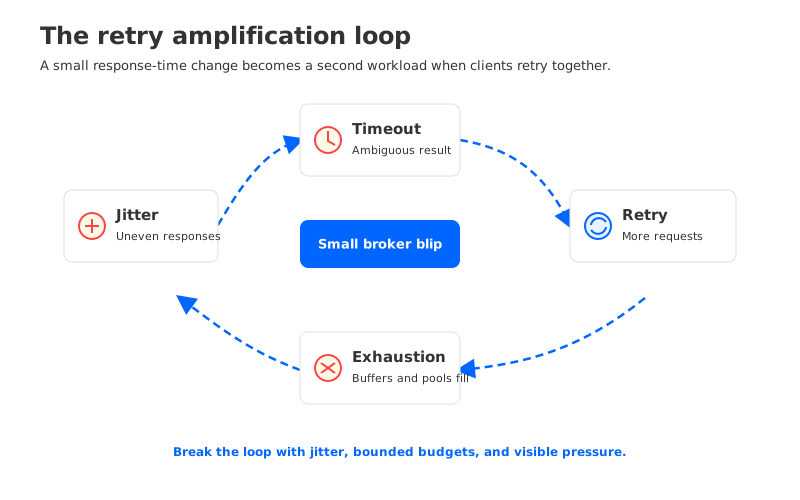
This is a feedback loop, not a single bad setting:
- Jitter creates uncertainty. The same request sometimes completes and sometimes exceeds its deadline, so clients disagree about whether to continue, fail, or retry.
- Timeouts create a boundary. When the boundary is too short, healthy-but-slow work is retried. When it is too long, applications hold resources while an unavailable path consumes their budget.
- Retries multiply work. A retry is another request competing with the first request, a metadata refresh, or a replica and leadership operation already in progress.
- Exhaustion moves the blast radius. Once producer buffers, connection pools, or application threads fill, the failure appears in upstream services rather than only in Kafka.
2The amplification loop: jitter, timeout, retry, exhaustion
Kafka retry storms are easiest to understand by separating three clocks. The first is the request clock: how long a client waits for one request response. The second is the delivery clock: how long a producer allows a record to remain in the send path before reporting failure. The third is the application clock: how long a service can hold a request, transaction, or work item before its own deadline expires. These clocks overlap, but they are not interchangeable.
The producer's request.timeout.ms is about one request and its expected response. It is not the total lifetime of a record. delivery.timeout.ms is the producer's upper bound for reporting success or failure after send() returns. Apache Kafka documents that this delivery budget includes time waiting before send, time awaiting broker acknowledgment, and time spent on retriable failures. It also documents that the delivery timeout should be at least the request timeout plus linger.ms.
If delivery.timeout.ms is shorter than the time a request needs under normal batching and recovery, the producer cannot use its retry budget coherently. If request.timeout.ms is much longer than the application's deadline, the producer can keep a request alive after the caller has abandoned the work. Neither problem is solved by increasing retries.
Backoff controls the spacing between attempts, while jitter prevents a fleet from waking on the same schedule. The names and exact behavior vary across Kafka client libraries, so platform teams should verify the implementation rather than assume that a Java producer's behavior is identical to a Python, Go, or .NET client. retry.backoff.ms and retry.backoff.max.ms are useful controls for the Java producer, but they are not a substitute for a total delivery budget or a limit on concurrent application work.
Consumer settings sit on a different path. fetch.max.wait.ms is the maximum time the broker may wait before returning a fetch response when the requested minimum data is not available. It affects fetch batching and tail latency. It is not a producer retry backoff, and reducing it will not stop a producer retry storm. A consumer incident may still amplify load if every consumer issues more frequent, smaller fetches while the broker is already under pressure, so its value belongs in a workload-specific fetch profile.
The distinction matters during diagnosis. Compare request latency, retry rate, producer buffer availability, connection count, metadata requests, consumer fetch rate, and broker saturation. A timeout spike with stable retries points to a budget problem; rising connections and falling buffer availability point to feedback. A fetch-rate spike with low record volume may mean consumers are turning an empty or slow topic into excess requests. The broader Kafka latency diagnostic guide follows the same producer-to-storage-to-consumer split.
3Timeout settings that actually mean what you think
Timeout changes are safest when they follow an explicit budget. Start with the application deadline and work inward. The client must have time to batch, send, await the response, back off, and make another attempt, but the total must remain shorter than the point at which the application can no longer use the result.
| Setting | Clock it controls | What it does not mean | Operator question |
|---|---|---|---|
request.timeout.ms | One request waiting for a response | The total record delivery time | Can a normal slow response finish before the client abandons it? |
delivery.timeout.ms | Producer record lifetime after send() returns | A guarantee that the broker did not accept a timed-out record | Does the budget cover batching, requests, and bounded retries? |
retry.backoff.ms | Delay before a retry attempt | A fleet-wide rate limiter | Will clients retry at different times, and does the library add jitter? |
retry.backoff.max.ms | Upper bound for exponential backoff | A replacement for an application deadline | Does the cap keep attempts from remaining too aggressive during an outage? |
fetch.max.wait.ms | Broker wait ceiling for a fetch | A consumer processing timeout or producer retry control | Does fetch cadence match the consumer's latency and batch needs? |
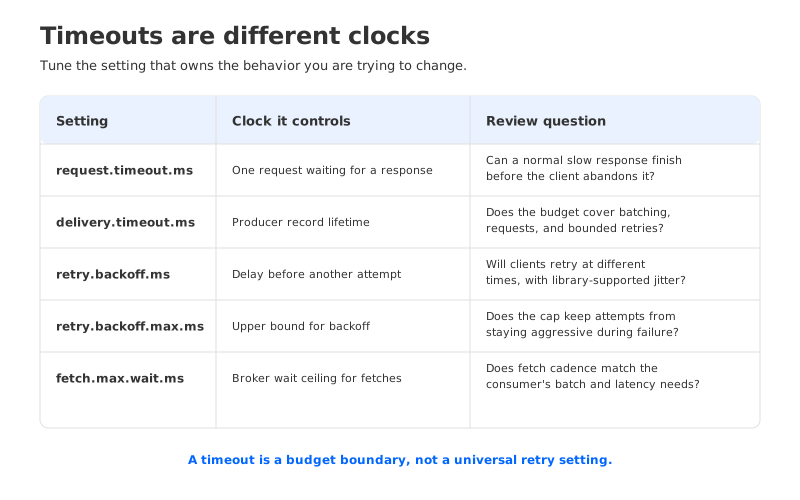
There is no universal value for this table. A request-response API producer, bulk ingestion producer, and replay consumer have different budgets. A platform baseline can define a safe range, while each exception should state the business deadline, duplicate policy, ordering scope, and test evidence.
Do not tune only the visible error. Lowering request.timeout.ms can fit a strict API deadline, but it can also make every producer reach the boundary during a leader election. Raising it may reduce immediate errors while keeping connection pools and request threads occupied longer. Measure queue and concurrency consequences, not only exception count.
4Idempotence versus ordering in the retry age
Retries create two separate correctness questions. First, can the producer resend a request without creating an unwanted duplicate? Second, if multiple requests are in flight, can a later batch become visible before an earlier batch that is being retried?
Kafka's idempotent producer protocol is designed to make retries safer within a producer session by using producer identity and sequence information. Apache Kafka's producer configuration also ties idempotence to related settings such as acknowledgments, retries, and the maximum number of in-flight requests. If idempotence is disabled while multiple requests are in flight, a failed earlier batch can be retried after a later batch succeeds, which can change record order for a partition.
Idempotence is not an end-to-end exactly-once guarantee. It does not make an external payment call idempotent, undo a database write, or decide what to do when a delivery timeout leaves acceptance uncertain. The application still needs an idempotency key, transaction boundary, or downstream deduplication rule when the side effect requires one.
Use the ordering requirement to choose the trade-off. If per-partition order matters, keep idempotence enabled where the client and workload support it, validate the in-flight limit, and test the behavior during delayed acknowledgments. If the workload can tolerate reordering but needs higher throughput, document that choice instead of inheriting it from a library default. The important policy is explicitness.
5Principles that keep client storms contained
Client configuration works best when it is paired with operational controls. The following principles are practical boundaries rather than universal defaults:
- Spread retry decisions. Use exponential backoff and library-supported jitter where available. If a client does not add jitter, introduce it at the retry policy or application layer, and verify that the added delay does not violate the delivery budget.
- Bound the total wait. Set
delivery.timeout.msagainst the business deadline, then check that request timeout, linger, backoff, and expected attempts fit inside it. A retry policy without a total budget is an open-ended queue. - Separate transient from permanent errors. Authorization failures, invalid records, serialization errors, and quota policies do not become healthy because a client sends the same request again. Retry only errors the client library and service contract classify as retriable.
- Make pressure observable. Track retry rate, timeout rate, request latency, producer buffer wait, in-flight requests, connection churn, metadata requests, and consumer fetch rate by
client.idand service owner. A cluster-wide average hides the one fleet that is creating the storm. - Test the recovery path. Delay acknowledgments, restart a broker, change partition leadership, throttle a client, and slow the downstream consumer. Record whether the application sees duplicates, reordering, lag, or timeouts, and whether the client fleet adds load while the cluster recovers.
These controls put a limit around the client side of the problem. The remaining question is whether the platform underneath creates avoidable recovery work that lengthens the period of uncertainty.
6Why the broker recovery model still matters
Client settings cannot make a storage and compute architecture behave like a different one. In traditional Kafka's Shared Nothing model, a broker owns local partition data and replication keeps copies across brokers. A restart, replacement, or scaling operation can therefore involve leadership changes, replica catch-up, and data movement at the same time as client traffic. That is a valid and widely used model, but its recovery work can overlap with retries.
This is the point where a Kafka-compatible shared storage system becomes relevant. AutoMQ keeps the Kafka protocol and client surface while replacing the traditional broker-local storage layer with Shared Storage. Its architecture uses WAL storage and object storage through S3Stream, so brokers are not tied to the same durable partition data ownership as in a local-disk design. AutoMQ's documentation describes stateless brokers, second-level partition reassignment, automatic scaling, and continuous traffic rebalancing as consequences of that design.
For retry storms, the benefit is narrower than "clients never retry." Networks, credentials, quotas, downstream services, and application processes can still fail. The architectural question is whether broker replacement or capacity movement adds another large source of delay and data movement while clients are already uncertain. Separating storage from compute can reduce that particular coupling, giving client budgets a steadier recovery path to measure.
Compatibility remains a test, not a slogan. AutoMQ publishes a Kafka compatibility guide, but teams still need to exercise their producer library, consumer behavior, authentication, transactions, monitoring, and failure handling. A platform change is successful when the same duplicate, ordering, and deadline decisions remain true during a broker event, not merely when the client connects.
The practical sequence is to fix the client contract first, then test the infrastructure model against it. For a self-managed Kafka deployment, that may mean measuring replication and rebalance work during a controlled broker event. For an AutoMQ evaluation, it means testing the same Kafka client profiles while observing WAL, object storage, broker, and client metrics. The comparison should be about the recovery work your application experiences, not a promise that one timeout value fits every workload.
Teams standardizing that contract can pair this incident model with the client retry semantics guide, which covers ownership, replay, and application-side effects.
7FAQ
7.1What causes a Kafka retry storm?
A retry storm occurs when many clients retry requests faster or more synchronously than the cluster can recover. Common triggers include uneven broker latency, a leader change, network loss, quota pressure, or a downstream service that blocks application threads. The retries then compete with recovery traffic and make the original fault harder to clear.
7.2What is the difference between request.timeout.ms and delivery.timeout.ms?
request.timeout.ms bounds the wait for one request response. delivery.timeout.ms bounds the producer's total time to report success or failure after send() returns, including batching, acknowledgments, and retriable failures. The latter is the application-facing delivery budget; the former is one part of it.
7.3Does fetch.max.wait.ms control Kafka retries?
No. It controls how long a broker may wait before returning a fetch response when the requested minimum data is not available. It can change consumer request cadence and latency, but it is not a producer retry backoff or a general client recovery timeout.
7.4Does idempotence prevent duplicate business actions?
It can make producer retries safer within a producer session, but it does not make an external side effect idempotent. Payment, database, email, and API workflows still need their own idempotency or deduplication boundary when duplicate execution is unsafe.
7.5Can shared storage eliminate retry storms?
No. Shared storage can change the broker recovery and scaling work that contributes to client-visible delay, but it does not remove network faults, application failures, quotas, or downstream backpressure. Client budgets, jitter, idempotence, and observability remain necessary.
8References
- Apache Kafka 4.1 producer configuration
- Apache Kafka 4.1 consumer configuration
- Apache Kafka design documentation: message delivery semantics
- Apache Kafka design documentation: replication
- Amazon MSK troubleshooting guidance
- AutoMQ architecture overview
- AutoMQ Kafka compatibility
9Keep the retry loop inside its budget
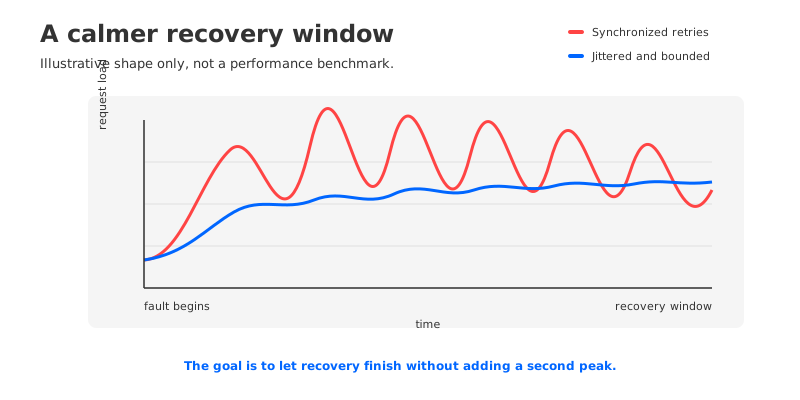
The hypothetical five-minute blip becomes an outage when every client interprets uncertainty as permission to add the same work at the same time. Start with independent retry timing, a delivery budget tied to the application deadline, explicit idempotence and ordering decisions, and metrics that show which client fleet is adding pressure.
Then test those rules against the broker recovery model underneath. Teams evaluating a Kafka-compatible shared storage architecture can try AutoMQ with their existing client profiles and compare the recovery path, not only the steady-state throughput. A calmer retry graph is not a client setting by itself; it is the result of clients and infrastructure failing in ways the application can afford.


