
Table of Contents
Table of Contents
An upstream platform outage can end before your team feels safe using the platform again. The status page turns green, producers reconnect, consumer lag falls, and the incident channel goes quiet. Then someone asks the question that matters: what makes us believe the next failure will be handled better?
That question is harder when your team did not cause the outage. You may not control the provider's code, change window, or incident process, but you still own the decision to keep routing business traffic through the platform. A post-incident review that stops at root cause leaves that decision unsupported.
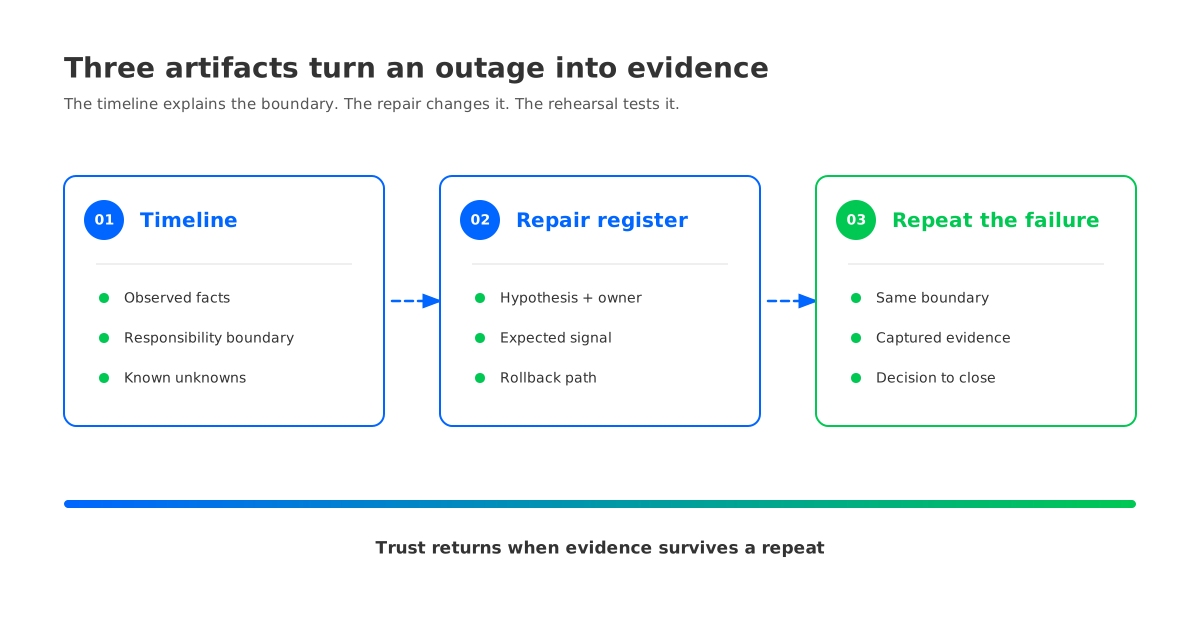
Kafka outage recovery becomes credible when it produces three things people can inspect: a time-ordered account of what happened, a repair with a measurable verification path, and a rehearsal that exercises the same boundary again. Those artifacts rebuild trust because they replace reassurance with evidence. They also separate the questions your site reliability engineering (SRE) team must answer internally from the narrower update customers need to hear.
1The outage ends, the distrust does not
The first mistake after a supplier incident is to treat service restoration as trust restoration. Service restoration answers whether requests work again. Trust restoration answers whether the team understands the failure, has reduced the same risk, and can detect a repeat before customers explain it to them.
Start by drawing the responsibility boundary. Record which component failed, which signals first showed impact, which requests were affected, and which parts of the path stayed healthy. Separate observed facts from working theories and from questions still waiting for evidence. A provider status update may explain an upstream dependency, but it does not describe your client retry behavior, consumer lag, alert coverage, or downstream reconciliation.
The timeline should be useful to someone who was not in the incident channel. Use timestamps from client logs, broker metrics, deployment records, provider notices, and operator actions. Keep the wording plain: “produce errors increased,” “the consumer group stopped making progress,” or “the storage endpoint returned errors.” Avoid turning a provisional explanation into a fact because it appeared early in the incident.
The timeline also needs a stopping point. “The provider recovered” is not enough. Mark when your clients recovered, when lag returned to its normal range, when alerts cleared, and when the team verified that acknowledged records and downstream state were consistent. Those are separate events, and collapsing them into one recovery time makes the incident look cleaner than the system actually was.
2Three artifacts that rebuild confidence
Trust improves when every important statement has a place where another engineer can check it. Build three artifacts and keep them linked to the same incident record.
-
A transparent timeline. Show the first customer-visible symptom, the first internal signal, major decisions, dependency updates, recovery actions, and the final verification. Add an explicit “unknown” row when the evidence does not yet support a conclusion. This is more useful than a polished narrative because it preserves the boundary between what the team saw and what it inferred.
-
A repair register. For each corrective action, write the failure hypothesis, the control being changed, the signal that should move, the owner, the rollback, and the date for verification. “Improve monitoring” is not a repair. “Alert when consumer lag and produce error rate diverge for the same workload” is closer, because the team can test whether the alert fires and whether someone knows what to do next.
-
A rehearsal record. Recreate the failure in a controlled environment, then capture the same evidence used in the timeline. Test the alert, the runbook, the escalation path, client behavior, and the recovery decision. A drill that ends with “the service came back” has not verified much. It should show which signals changed, which action was taken, how the team decided to stop, and what still needs work.
The three artifacts form a loop: the timeline tells you which boundary failed, the repair register states what should change, and the rehearsal tests whether the change is visible under pressure. The same discipline appears in a traffic shadowing runbook, where a target platform is judged by observable client behavior and rollback evidence rather than a successful deployment alone.
The repair register should also state what the fix does not cover. A client timeout change may reduce retry pressure while leaving a storage dependency untouched. An alert added after the incident may shorten detection while leaving recovery manual. Naming the remaining boundary protects the team from declaring victory because one metric improved.
3Internal comms versus external comms
Internal and external communication serve different decisions. Internal communication helps engineers choose what to change and who owns the next test. External communication helps customers understand impact, action, and the next reliable update. Using one message for both audiences usually hides the details engineers need or exposes uncertainty without useful context.
| Audience | The decision it supports | Include | Leave out |
|---|---|---|---|
| SRE and platform engineering | Can we operate the platform safely through a repeat? | Observed signals, hypotheses, control changes, owners, runbook steps, and pass conditions | Blame language and unverified root cause claims |
| Product and engineering leadership | Should the platform remain on the critical path? | Scope, business impact, risk accepted, repair status, and evidence still missing | A dashboard screenshot without a decision or owner |
| Customer support and account teams | What can we tell affected users? | Impact window, affected behavior, current state, customer action, and next update point | Internal disagreement, speculation, and promises outside the team's control |
| Customers | What happened to our workload and what should we expect? | Plain impact statement, recovery status, data handling, and the evidence available to share | A long internal timeline or a claim that the risk is gone forever |
The internal message should be specific enough to drive a change. It can say that a dependency failure exposed a blind spot in consumer lag alerts, or that the team could not distinguish client retries from broker unavailability during the first minutes. The external message should be equally honest but narrower: name the affected behavior, state whether the team found evidence of data loss or is still checking, and give the next update condition.
Do not make “the provider caused it” the end of the explanation. The provider may own the failed component, while your team still owns client configuration, observability, fallback behavior, and the decision to keep the dependency in the critical path. That separation lets you hold a supplier accountable without using supplier accountability as a substitute for your own recovery work.
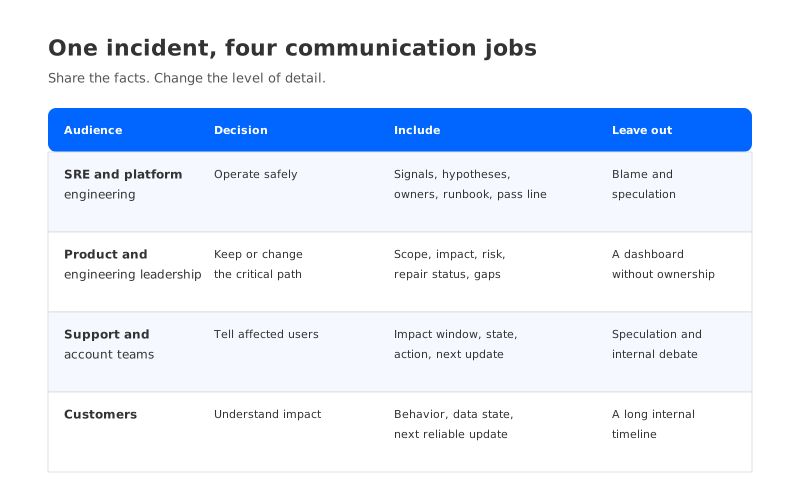
Give operators the internal record and affected users the external record. Share facts and timestamps, then tailor the level of detail to the decision each audience must make.
4Proof, not promises: evidence that sticks
Evidence earns trust when it connects a system signal to a user outcome. A green broker health check does not prove that a producer can publish, a consumer can make progress, or a replay can finish. Choose signals that follow the workload across the failure boundary.
For an Apache Kafka® platform, the evidence set may include produce and fetch error codes, request latency, consumer lag, leader changes, under-replicated partitions, offline partitions, and Controller state. Kafka's monitoring guidance and replication documentation provide the vocabulary for these signals. The min.insync.replicas configuration also matters when the incident touches write acknowledgments and replica availability.
The evidence should answer four questions:
- Detection: Which signal showed the problem first, and how close was it to the customer symptom?
- Containment: Which action reduced the blast radius, and what evidence shows that it worked?
- Recovery: When did producers, consumers, and downstream systems return to their expected state?
- Repeatability: Can the team trigger the same alert and walk the same runbook without relying on one person's memory?
Do not invent a universal recovery threshold. Use the workload's historical baseline and the business impact to set a pass condition, then keep that condition stable between drills. If the baseline is missing, the first repair may be to collect it. That is a more honest outcome than selecting an attractive target after the test has finished.
This is where architecture changes the evidence available to the team. If durable records, broker compute, client routing, and provider operations all sit behind one service boundary, an incident review may depend on a support case for part of the timeline. A BYOC model can expose more of the data plane's network, storage, identity, and runtime evidence to the customer team, but it does not remove upstream dependencies. The boundary must be tested rather than assumed. For a broker-local storage model, a separate review of Kafka storage and recovery pitfalls helps identify which evidence belongs to the broker, its volume, and its placement.
AutoMQ is one example of this control model. In AutoMQ BYOC, the control plane and data plane run in the customer's cloud account and Virtual Private Cloud (VPC). That gives the platform team a clearer place to collect network, identity and access management (IAM), object storage, and workload telemetry within its responsibility boundary. It does not turn a deployment into an SLA, and it does not make a provider incident impossible.
AutoMQ's Shared Storage architecture also changes what a recovery drill should observe. Durable stream data is held in object storage, while brokers handle Kafka protocol work, coordination, caching, and the active write path. The WAL storage documentation describes the write-ahead layer used for persistence and recovery before data reaches object storage. A drill should therefore inspect broker reattachment, WAL behavior, object storage access, client recovery, and consumer progress as separate observations. The design moves the failure questions; it does not answer them for you.
If your team is evaluating that boundary, the Kafka compatibility documentation is a starting point for client behavior. Pair it with a production-shaped rehearsal that uses your producers, consumers, retention, security policy, alerts, and rollback path. A platform earns trust when the evidence is available to the people who must act during the incident.
5A trust recovery scorecard
Use the scorecard as a decision record. Mark a row green only when the artifact exists, an owner can explain it, and the claim has been tested. Mark it yellow when the work has an owner and a next verification date but the evidence is incomplete. Mark it red when the boundary, owner, or test is missing. Do not average the colors. One red row in customer impact or recovery ownership can outweigh several green rows in dashboard coverage.
| Area | Green means | Evidence to attach | Next action when yellow or red |
|---|---|---|---|
| Timeline | Facts, inferences, unknowns, and responsibility boundaries are separated | Incident record, client logs, provider notice, operator actions | Assign an owner to close each unknown or record why it remains open |
| Repair | Every corrective action has a hypothesis and a signal | Repair register, change record, alert test | Define the signal and rollback before closing the task |
| Observability | Customer symptoms can be connected to platform signals | Produce, fetch, lag, replication, storage, and network views | Add the missing view and test it during a controlled fault |
| Rehearsal | The team can repeat the failure and follow the runbook | Drill log, timestamps, captured metrics, decision points | Schedule a drill with the same dependency boundary |
| Ownership | Someone can act at each escalation step | On call, supplier, product, and customer communication owners | Write the handoff and the first action each owner takes |
| Customer impact | The affected behavior and data state are understood | Support summary, reconciliation result, customer update | Keep the incident open until the impact statement is supportable |
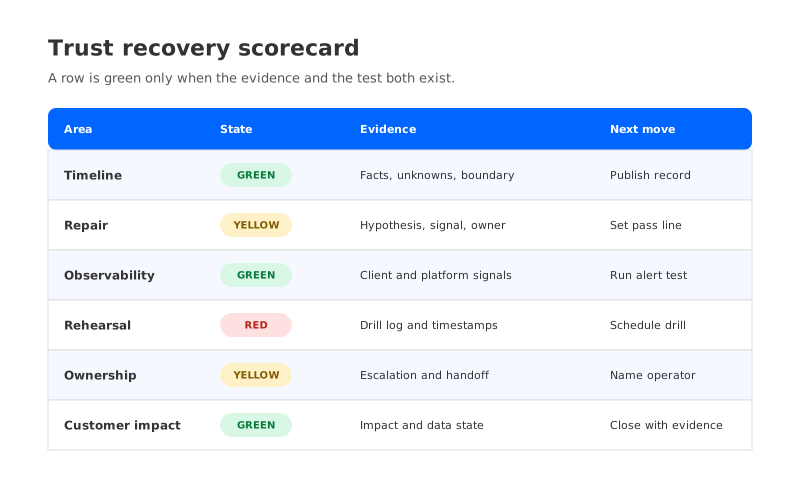
The most useful scorecard changes the next review. A red rehearsal row schedules a drill; a yellow customer-impact row keeps reconciliation open. If BYOC or Shared Storage moves evidence into your team's boundary, add those logs and access checks instead of treating visibility as a promise.
An outage you did not cause can still reveal a trust problem you own. The repair is a record that explains the failure, a fix whose effect can be observed, and a rehearsal that makes the recovery path familiar before the next alert arrives. If you want to test that model against your own Kafka workload and cloud boundary, start an AutoMQ BYOC evaluation with the scorecard filled in. Bring the hardest failure path, the evidence you can access, and the row you currently cannot mark green.
6References
- Apache Kafka monitoring
- Apache Kafka replication
- Apache Kafka
min.insync.replicasconfiguration - AutoMQ compatibility with Apache Kafka
- AutoMQ BYOC overview
- AutoMQ Shared Storage architecture
- AutoMQ WAL storage
- Runbook design for traffic shadowing for migration
- Stateful Kafka on Kubernetes: storage pitfalls and architecture alternatives
7FAQ
7.1How do you recover trust after a Kafka outage?
Treat trust as an evidence problem. Publish a transparent timeline, link each repair to a signal and an owner, then rehearse the same failure boundary. Service restoration is one event in that chain, not the entire recovery.
7.2What should a Kafka post-incident review contain?
It should separate observed facts, inferences, and unknowns; describe customer impact; identify the responsibility boundary; record corrective actions; and attach verification results. Include client behavior, consumer progress, data reconciliation, and the next rehearsal when those areas were part of the incident.
7.3How should internal and external Kafka incident communication differ?
Internal communication should help engineers act, so it needs hypotheses, metrics, owners, runbook steps, and pass conditions. External communication should explain impact, current state, customer action, and the next update point in plain language. The records can share evidence without sharing every internal detail.
7.4Does BYOC guarantee better Kafka outage recovery?
No. BYOC changes the responsibility and evidence boundary. With AutoMQ BYOC, the control plane and data plane run in the customer's cloud account and VPC, which can give the customer team direct access to more runtime, network, identity, and storage evidence. The team still needs to test dependencies, client behavior, storage access, and recovery procedures.
7.5What should a Kafka reliability recovery scorecard measure?
Track the timeline, corrective actions, observability, rehearsal, ownership, and customer impact. Mark each row by the evidence available and the verification state. Keep unresolved rows visible until an owner and a repeatable test exist.


