
Table of Contents
Table of Contents
A Kafka portability review can look complete when the broker endpoint is reachable and a test Producer can publish a Record. Then the first production Connector fails to load, a Consumer cannot decode an older payload, or a client starts retrying because its timeout and authentication assumptions came from the previous environment. Ecosystem work was distributed across registries, worker pools, and deployment templates.
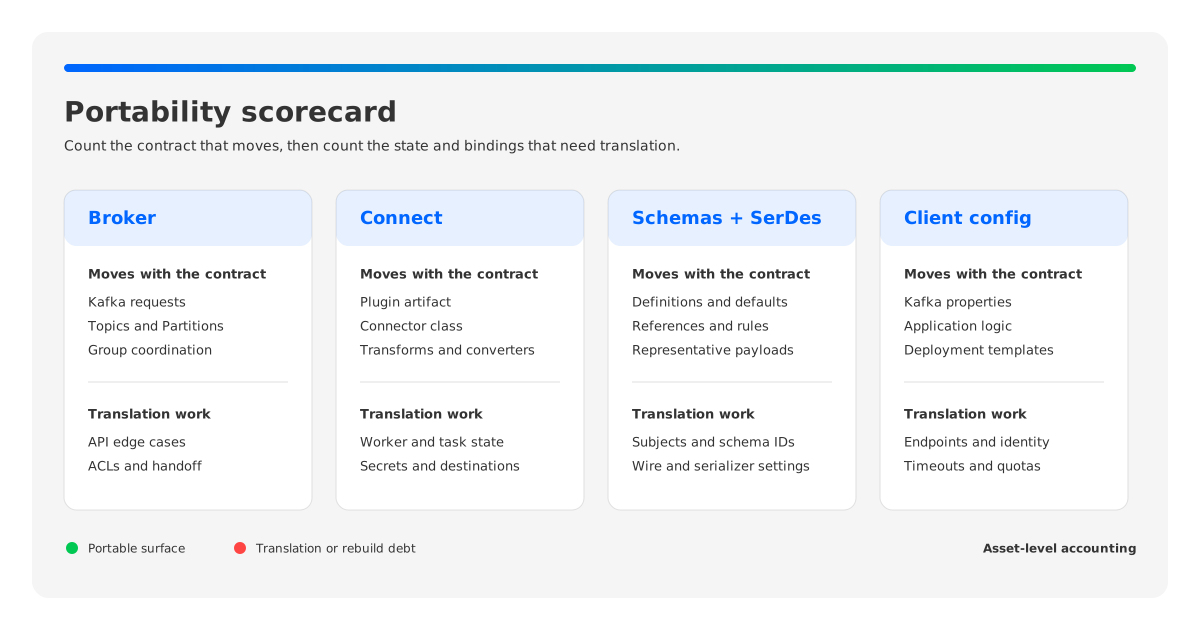
Kafka portability should be measured as an asset inventory, not as a claim about API compatibility. The switch cost often sits in three surrounding contracts: Kafka Connect plugins and runtime dependencies, schemas and serialization formats, and the effective configuration carried by Producers, Consumers, and admin tools. A compatible Kafka protocol can reduce broker-side changes while leaving those contracts for your team to prove.
1The broker is visible, but the ecosystem carries the work
A broker migration gives the team a clear endpoint to test: bootstrap servers, Topic metadata, Produce requests, Fetch requests, and administrative operations. Those checks are necessary, but they are an incomplete definition of portability. A green smoke test says little about the Connector that writes to a warehouse, the schema subject that a Consumer resolves, or the TLS and SASL settings injected by a deployment system.
Ask which assets can be exported, which need translation, and which are bound to the old runtime. Keep the broker as one row in the ledger, then test the surrounding contracts independently.
| Asset family | What may move | What usually creates switch work |
|---|---|---|
| Broker and Kafka API | Topic and Partition operations, Produce and Fetch behavior, group coordination, and AdminClient calls | Version gaps, protocol edge cases, Topic settings, ACLs, transaction behavior, and data handoff |
| Kafka Connect | Plugin artifact, connector class, transforms, converters, and declarative configuration | Worker runtime, internal Topics, task offsets, status records, secrets, network routes, and destination permissions |
| Schemas and SerDes | Avro, JSON Schema, Protobuf, or other definitions, defaults, references, and compatibility rules | Subject naming, schema ID namespaces, registry authentication, wire format, and serializer settings |
| Client configuration | Standard Kafka properties, application code, and deployment templates | Bootstrap addresses, trust bundles, SASL mechanisms, quotas, rack hints, timeouts, and vendor-specific properties |
This table changes the migration conversation. “We can reuse the client” may be true at the code level while false for the effective deployment. Portability belongs to the individual asset and its contract.
2Kafka Connect portability stops at the runtime boundary
Kafka Connect is portable in layers. The plugin is a software artifact that implements a Connector, Source or Sink behavior, and often a set of Transform and Converter classes. The running integration also depends on a Worker runtime, plugin path, Kafka client settings, internal Topics, task state, credentials, network reachability, and the external system at the other end. Treating those pieces as one “Connector” row hides the work.
Start with the artifact. Record the plugin name and version, connector class, dependency files, converter, transforms, and the Kafka Connect and Kafka client versions against which it was tested. A plugin built against documented Kafka Connect interfaces has a clearer portability boundary than one that calls private worker hooks or relies on a provider-specific extension.
Then map the runtime dependencies. A source Connector may store task offsets in internal Topics and depend on a database user present in the original network. A sink Connector may load correctly but fail when the target table, object-store path, or idempotency rule is different. Secret names, private endpoints, certificate chains, and dead-letter Topics are part of the running integration even when they are absent from the plugin repository.
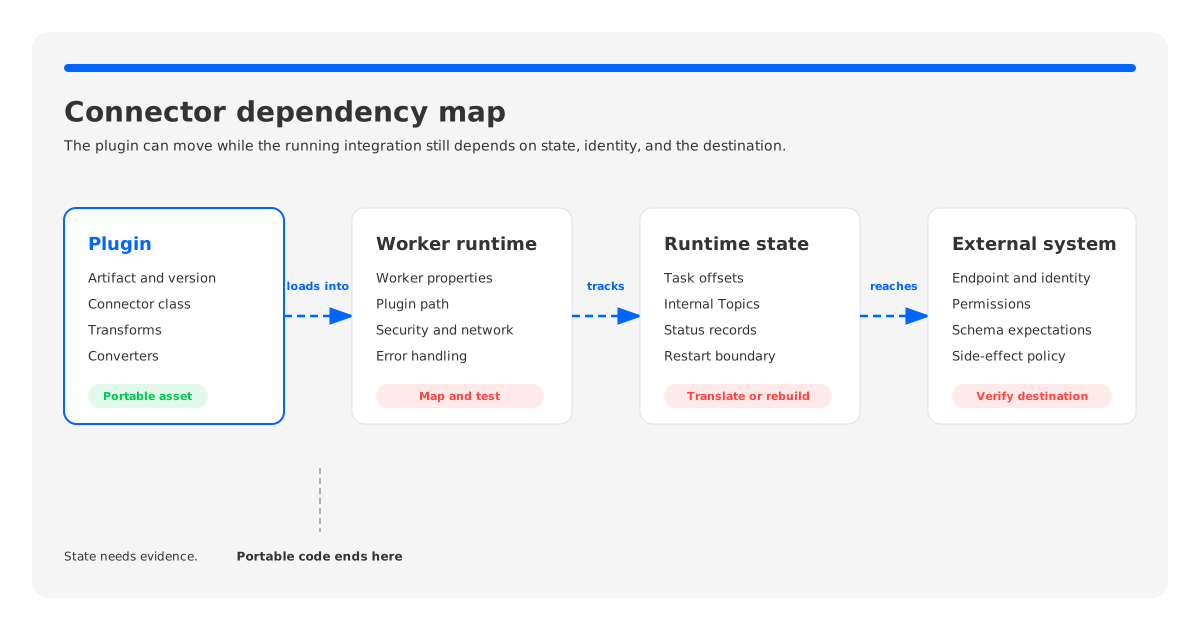
A useful inventory uses four rows for every Connector:
- Plugin: artifact, version, dependency set, Connector class, Transform classes, and Converter classes.
- Configuration: connector properties, worker properties, internal Topic names, error handling, and dead-letter behavior.
- Runtime state: task offsets, status records, restart policy, and the point from which a source or sink can resume.
- External dependency: source or destination permissions, endpoint, schema expectations, network path, and downstream idempotency.
The first row is often reusable code. The other three decide whether the integration can be restored without changing its behavior. A clean Worker test must load the plugin, reach the external system, process representative data, and resume at a known boundary. A connector lifecycle readiness checklist can provide the evidence fields.
3Schema portability includes the wire format beyond the definition
A schema file is portable when the target can interpret the bytes that reference it. Registry migration often separates the definition from the identity system that clients use. A subject name, version, compatibility mode, schema ID, reference, authentication method, and serializer configuration can all affect whether an existing Record remains readable.
The important distinction is between a data contract and a registry address. Avro, JSON Schema, or Protobuf definitions can live in source control and move to another service. The registry namespace may not. If schema IDs are assigned from a different namespace after cutover, a Consumer that sees an old ID may request the wrong definition or fail before it can inspect the payload. If subject naming changes, a compatibility check may pass for the text of the schema while the running serializer still looks up a different subject.
Treat schema migration as a paired test of definitions and encoded Records. Export the active definitions, references, defaults, compatibility rules, subject mapping, and representative payloads. Then validate three paths: historical Records, Records produced during the handoff, and the next schema version after the target becomes authoritative. The test should use the same Serialization / Deserialization configuration as the application, including the format carried in the Record headers or value envelope. Schema compatibility gates use the same production-evidence lens.
Teams usually choose between preserving registry identity, translating IDs and subjects with a compatibility layer, or decoding and re-encoding through an application or replication path. None of these approaches is implied by Kafka protocol compatibility alone.
The handoff boundary should be explicit. Decide whether source and target Producers can publish at the same time, whether Consumers must understand both registry namespaces, and whether a failed cutover can send traffic back without creating two authoritative schema histories.
4Client configuration is an operational API
Client code is often the most portable layer because standard Kafka APIs keep message handling, batching, acknowledgments, retries, and Consumer group logic in the application. The deployment configuration is where platform assumptions accumulate. A client can compile unchanged and still behave differently because the target has a different bootstrap address, security mechanism, certificate chain, quota policy, or retry envelope.
Inventory the effective configuration rather than the defaults in a source repository. For each critical Producer, Consumer, Streams application, and AdminClient, capture the values that reach the process after Helm, Terraform, environment variables, secret injection, and sidecar templates have been applied. Classify each property as standard Kafka behavior, environment binding, or platform-specific behavior.
Pay particular attention to properties that change the failure and recovery path:
- Connection: bootstrap servers, DNS names, advertised addresses, listener protocols, and private endpoint settings.
- Security:
security.protocol, SASL mechanism, JAAS or credential reference, TLS trust material, certificate rotation, and ACL assumptions. - Delivery: acknowledgments, idempotence, transactions, compression, batching, request limits, retries, and delivery timeout.
- Consumption: group ID, offset reset behavior, session and poll timing, fetch limits, cooperative assignment, and replay policy.
- Placement and protection: rack or zone hints, quotas, client IDs, telemetry endpoints, and shutdown behavior.
The first two groups usually need environment mapping. The last three need workload tests because they shape ordering, duplication, throughput, and recovery. Do not replace every property mechanically. Compare the effective values, ask what behavior each one protects, and remove assumptions the target does not need.
5Score portability before committing to a switch
A practical scorecard needs to distinguish “we have a file” from “we have evidence.” Use a planning heuristic: score 0 for an unknown or private dependency, 1 for an exported asset that needs translation or testing, and 2 for a versioned asset tested on the target path. This is not a vendor benchmark.
| Row to score | Evidence for 0, 1, or 2 | Owner |
|---|---|---|
| Connect plugin | Plugin or dependency boundary is unknown; artifact exists but runtime is untested; clean Worker loads and exercises it | Data integration |
| Connect runtime | Worker state is coupled to the source; internal Topics or offsets need mapping; restore and resume test passes | Kafka platform |
| Schema definitions | Definitions are missing; definitions exist but subjects or IDs need translation; encoded samples pass before and after cutover | Data governance |
| SerDe and wire format | Serializer behavior is undocumented; format is known but registry lookup differs; historical and future Records decode | Application team |
| Client configuration | Effective values are scattered; values are captured but environment-specific; reproducible deployment passes behavior tests | Platform engineering |
| Security and identity | Credentials or trust material depend on private systems; mapping is documented; authentication and ACL tests pass | Security and SRE |
| Rollback boundary | No owner or cutover point; rollback needs reconciliation; reversal and downstream repair are rehearsed | Migration lead |
| Broker protocol and semantics | Required API behavior is unknown; compatibility is claimed but edge cases are open; workload matrix passes | Kafka platform |
A low total is a signal to stop calling the system portable until red rows have owners. The useful output is a translation list: schema IDs, Connector checkpoints, client changes, and downstream reconciliation. Contract dependency maps add a related way to record those boundaries.
6What Kafka compatibility can and cannot carry
Kafka protocol compatibility gives the team a valuable starting point. It can preserve the request and response surface used by Kafka clients, Topic and Partition semantics, group coordination, and the integration point that Kafka Connect uses to talk to the cluster. It does not automatically copy Worker state, schema registry identity, secret bindings, destination permissions, or the configuration injected by the old environment.
After those requirements are clear, AutoMQ is a concrete example of the compatibility approach. AutoMQ is a Kafka-compatible cloud-native streaming platform that uses a Shared Storage architecture, with S3Stream and S3-compatible object storage underneath the Kafka data plane. The architecture changes where durable data lives and how AutoMQ Brokers scale, while the Kafka protocol and upper-layer semantics remain the integration boundary.
That design can reduce broker-layer changes during an ecosystem migration. AutoMQ documentation describes compatibility with Apache Kafka clients and Kafka Connect, and its migration guidance recommends maintaining an existing Connector service while replacing the Kafka server endpoint, subject to the Connector and workload tests described above. The same documentation does not make schema registry subjects, SerDes, credentials, or client deployment values migrate automatically. Those remain explicit rows in the switch-cost ledger.
The useful question for an AutoMQ evaluation is narrow: can the existing client, Connector, schema, and configuration contracts pass the target test matrix while the storage layer changes underneath? If yes, Kafka compatibility has reduced broker-layer work. It has not erased the ecosystem accounting that makes the answer credible.
7A switch-cost self-assessment you can run this week
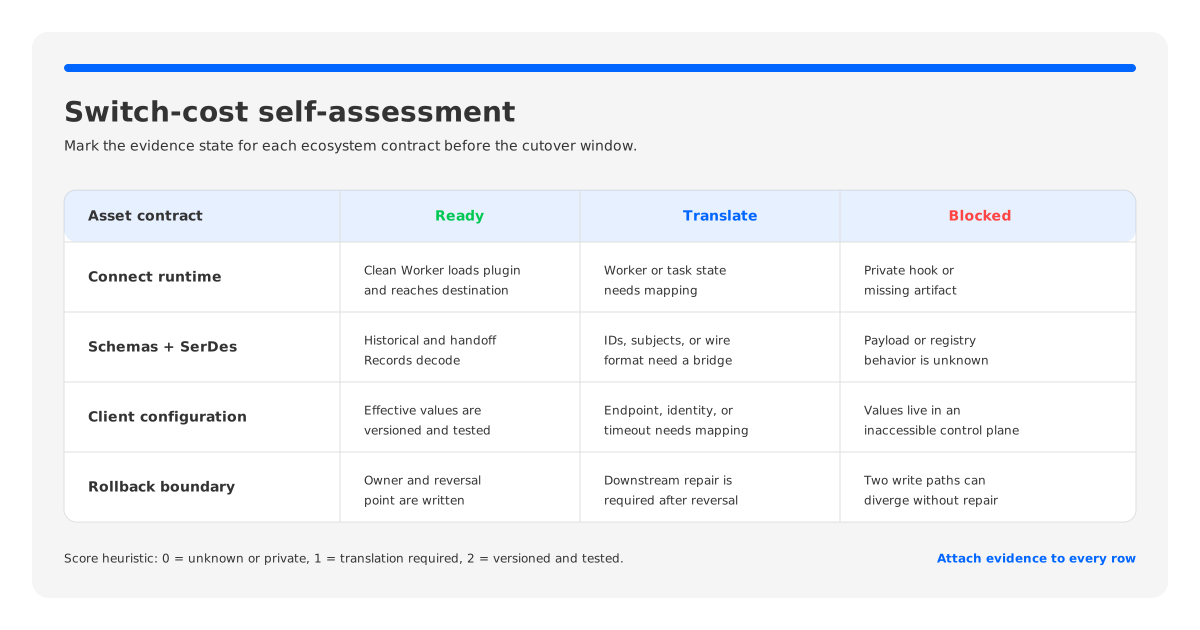
Choose one production workload with a representative Producer, Consumer group, Connector, and schema family. The point is to expose contracts that a clean smoke test misses. For each row, mark Ready, Translate, or Blocked and attach one piece of evidence.
| Question | Ready | Translate | Blocked |
|---|---|---|---|
| Can a clean Worker load every required plugin and dependency? | Artifact and version test pass | Runtime or dependency mapping is written | Private hook or missing artifact |
| Can the target read historical and handoff Records? | Decode tests pass with production SerDes | IDs, subjects, or formats need a bridge | Payload or registry behavior is unknown |
| Can each critical client reproduce its effective configuration? | Deployment output is versioned and tested | Endpoint, identity, or timeout values need mapping | Values live in an inaccessible control plane |
| Can Consumers resume without an accidental replay or gap? | Offset or checkpoint rule is verified | Replay needs reconciliation | Progress state is missing or ambiguous |
| Can a Connector reach its source or destination with the same ownership? | Permissions and side effects pass | Network, credentials, or destination mapping is open | Destination behavior cannot be tested |
| Can the team reverse the cutover? | Reversal owner and boundary are written | Downstream repair is required | Two write paths can diverge without a repair plan |
The worksheet tells teams which part is portable, which part needs translation, and which part still depends on a private runtime. If the first migration review stops at broker connectivity, repeat it with the Connector, schema, and effective configuration rows beside the test results. For a Kafka-compatible target that you want to evaluate with your own workload and runbook, start an AutoMQ evaluation.
8References
- Apache Kafka protocol
- Apache Kafka Connect
- Apache Kafka configuration
- AutoMQ compatibility with Apache Kafka
- AutoMQ Kafka Connect plugins
- AutoMQ Kafka Connect management
- AutoMQ architecture overview
- AutoMQ migration from Apache Kafka
9FAQ
9.1What does Kafka portability mean?
Kafka portability means that a workload's records, client behavior, Connect integrations, schema contracts, and operating procedures can be moved or rebuilt across Kafka-compatible platforms with a known amount of translation. It is an asset-level claim, not a single platform-wide switch.
9.2Is Kafka Connect portable between platforms?
The plugin artifact may be portable when it uses the Kafka Connect contract and documented dependencies. The Worker runtime, internal Topics, task offsets, secrets, network path, and destination permissions need separate export and validation.
9.3What makes Kafka schema migration difficult?
Schema definitions are one layer. Subject names, schema ID namespaces, compatibility rules, references, serializer settings, and the wire format used by existing Records must also remain readable during the handoff.
9.4Does Kafka protocol compatibility migrate client configuration?
No. Protocol compatibility can preserve the Kafka request and response boundary, but bootstrap addresses, security, trust material, quotas, timeouts, placement hints, and deployment bindings still require an environment mapping and workload test.
9.5How should a team estimate Kafka switch cost?
Inventory the broker, Connect, schema and SerDe, and client configuration assets. Mark each row Ready, Translate, or Blocked, then attach evidence from a clean target test, a cutover rehearsal, or a documented mapping. The blocked rows are the work to budget.


