


Overview
AutoMQ Cloud is a new generation of fully managed Kafka cloud service provided by AutoMQ (Hangzhou) Technology Co., Ltd. Using AutoMQ Cloud enables enterprise developers to easily build and run event stream processing applications in a Public Cloud environment without worrying about cluster operations and maintenance. AutoMQ Cloud is 100% compatible with open-source Apache Kafka and offers significant enhancements and improvements for enterprise-level scenarios such as high availability and disaster recovery architecture, elasticity, and observability operations compared to Apache Kafka. The AutoMQ Cloud BYOC mode deploys software services in the user’s cloud account, ensuring that data does not leave the user’s VPC, thereby achieving higher privacy protection and data security standards.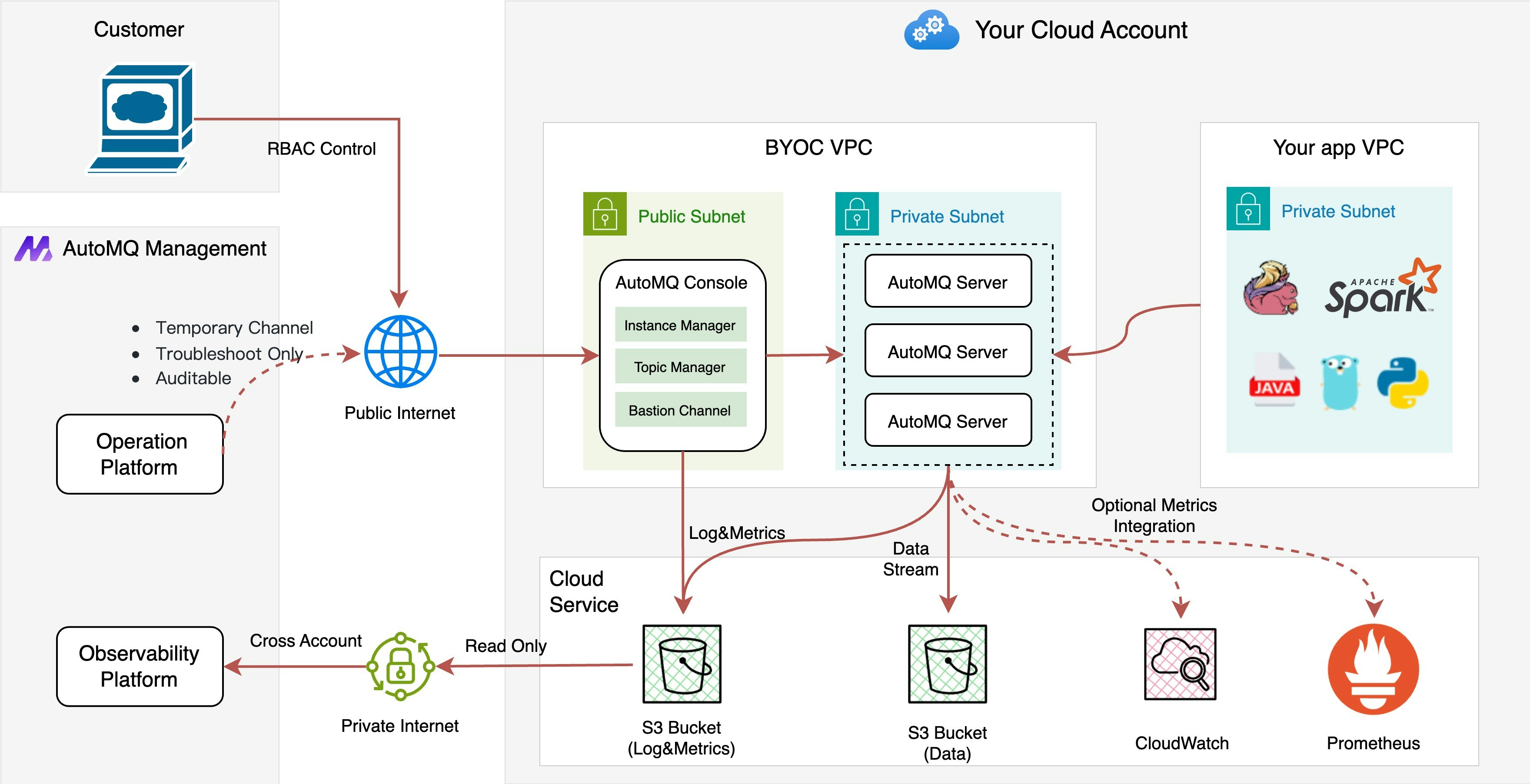
Core Advantages
AutoMQ Cloud offers the following advantages:Pay-as-you-go, with a 50% Reduction on Cloud Bills
AutoMQ’s new cloud-native architecture fully leverages object storage and cloud elastic computing resources, providing significant cost advantages over Apache Kafka and other competitor solutions. By enabling AutoMQ Cloud, you can fully utilize resources on demand and pay-as-you-go, with a 50% reduction on cloud bills.Fully Managed, Maintenance-free, with SLA Assurance
AutoMQ Cloud is a fully managed cloud service offered by the AutoMQ Team for Public Cloud environments. Users can start using the service with just one click, without worrying about cluster deployment, changes, or other maintenance operations. The AutoMQ Team provides 24/7 operational support and SLA assurance.Supports BYOC, Resources Deployed in User VPC, No Cross-network Data
The BYOC model of AutoMQ Cloud means that cloud resources are deployed in the user’s VPC. Users can access AutoMQ without cross-network connectivity and can also utilize existing cloud account resource discounts.Enterprise-Level Capabilities Out of the Box
AutoMQ Cloud enhances the Community Edition with enterprise-level features such as auto-scaling, second-level partition migration, and integrated system observability. Users can utilize these enhancements immediately upon service activation without additional development.Native Multi-Cloud Support
The cloud-native architecture of AutoMQ relies solely on Public Cloud-based object storage and virtual machine products, inherently supporting multi-cloud deployments. Enterprise customers can activate and use AutoMQ Cloud within mainstream cloud environments.Choosing the Service Version
AutoMQ offers AutoMQ Cloud and AutoMQ Enterprise for enterprise customers. The former is a fully managed cloud service provided by the AutoMQ Team, available in both SaaS and BYOC models; the latter is an enterprise distribution software provided for IDC private deployment scenarios. Enterprise customers can refer to the table below to select the most suitable service version.| SaaS Fully Managed Service [1] | BYOC Fully Managed Service [2] | On-Premises Software [3] | |
Primarily for Public Cloud environments, supporting major Cloud providers:
| Primarily for IDC environments, supporting the following storage technology stacks:
| ||
| IaaS resources owned by AutoMQ cloud account | IaaS resources owned by user cloud account | IaaS resources owned by user | |
| 100% secure, entrusted to AutoMQ cloud account for management | 100% private, data remains within the user VPC | 100% private, data remains within the user private network | |
One-click activation via cloud marketplace, official website, etc., fully managed services covering the following scenarios:
| All maintenance operations executed by the customer, with remote technical support provided by the AutoMQ technical team | ||
|
| ||
| Subscription fee (pricing includes cloud resources) |
|
| |
|
| ||
| Default option for public cloud customers | Suitable for some public cloud customers who wish to reuse IaaS discounts, keep data within the VPC, and accept operational authorization | Suitable for financial, government, and enterprise customers requiring data sovereignty, complete environment isolation, and offline IDC | |
Related Content
- Quick Experience of AutoMQ Cloud: Overview▸